- Home
- Posts
- The State of Newsletters 2026
The State of Newsletters 2026
Trends, Growth, and What’s Next for Email in 2026


Kanishka, Tyler Denk & Taylor Cromwell
January 06, 2026
If 2025 was the year newsletters proved their staying power, 2026 will be the year they become the center of the content economy.
While every social platform is wrestling with algorithm volatility, shifting content policies, and AI-curated feeds, email will continue doing what it has always done: reliably reaching opt-in audiences through creator-owned distribution.
It’s more predictable.
More measurable.
More owned.
When someone subscribes, they’re opting into an ongoing, permission-based relationship.
You commit to showing up with useful, relevant work; they commit to opening, reading, and responding. That mutual agreement is rare in a landscape where almost everything else is pushed by feeds and algorithms, rather than intentionally requested.
For this report, we pulled newsletter growth and monetization data from across beehiiv and spoke with leading newsletter founders, operators, and publishing experts to understand what’s driving the next phase of email-first publishing.

The data tells the story:
Publishers sent 28 billion emails last year and reached more than 255 million unique readers.
Engagement is rising too, with open rates hitting 41%+, even as inbox competition grows.
Publishers earned millions across ads, paid subscriptions, partnerships, boosts, and hybrid monetization stacks that didn't exist a few years ago.
New monetization tools helped creators earn faster: for newsletters launched in 2025, the median time to a first dollar dropped to 66 days.
Paid subscriptions, the strongest-performing revenue channel, generated $19M in 2025 vs. $8M in 2024, a 138% jump, driven by niche creators delivering specialized expertise.
It shows what actually worked in 2025 and what will drive results in 2026: the benchmarks, the growth engines, the revenue shifts, and the creative decisions behind breakout newsletters.
Newsletters you read every day — publishers like TIME, Half Baked, Girlboss, Status News, Generalist World, Garbage Day, LNI Media, The Pour Over, Tyler Denk, Austin Rief, and Michael Kauffman — are treating newsletters like media companies. They built communities, ran events, launched companion formats, and gave their audiences reasons to stick around.
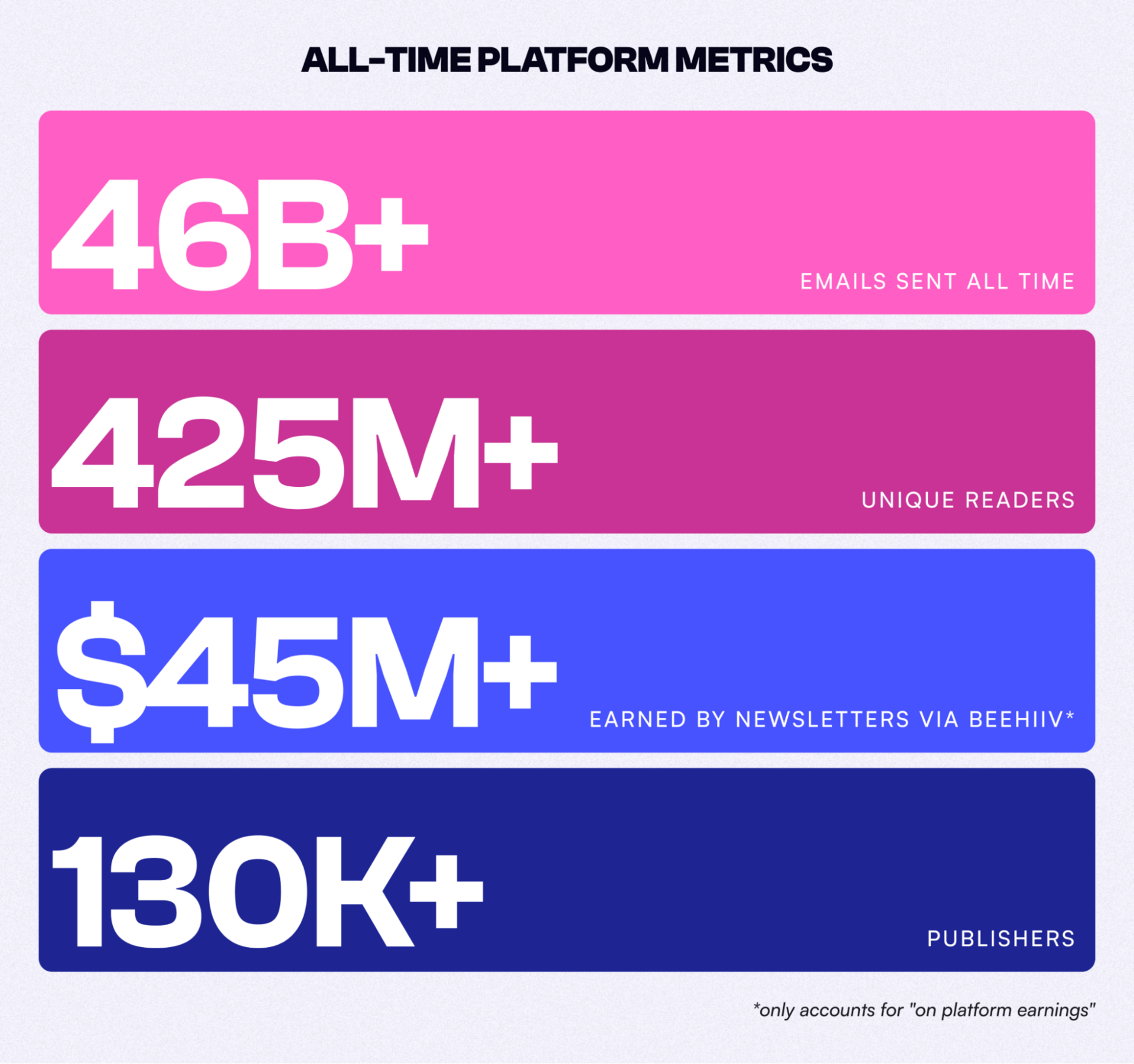
Snapshot: The State of Email Newsletters in 2025
To get an inside look at the newsletter industry, we went deep into the data: everything from open rates across dozens of industry newsletters to trends across paid subscriptions, subscriber growth, and more.
We also spoke to leading creators and newsletter publishers to get their take on where we’re at right now and where the biggest opportunities are in the year ahead.
In 2025, we saw the influence of several key trends in the email newsletter landscape:
We had countless reminders that when you build on rented platforms, you can lose access overnight. (Just ask any newsletter that saw traffic from X/Twitter drop due to a policy change, or a small TikTok business whose sales plummeted during a temporary ban.)
As Francis Zierer, Lead Editor at Creator Spotlight, beehiiv, notes, it’s unlikely that platforms that don’t allow you to export follower contacts will suddenly grant that ownership.

The endgame is still to bring followers into an ecosystem you control – often, via email.
2. Gmail’s AI filters and bulk-sender rules are reshaping who even gets an open, while Apple’s privacy features are reshaping how opens are measured.
In 2025, Gmail, Outlook, and Yahoo all strengthened enforcement policies that prioritize senders with consistently engaged audiences, while filtering out mail sent to large, inactive segments.
Apple’s Mail Privacy Protection (MPP) has made the traditional open rate less reliable, as it auto-loads images.
beehiiv, however, proactively filters out most bot activity to provide accurate open data. Industry-wide, we’ve seen a shift toward measuring “true” engagement metrics, like verified clicks, replies, and post-email actions, to gauge audience interest.
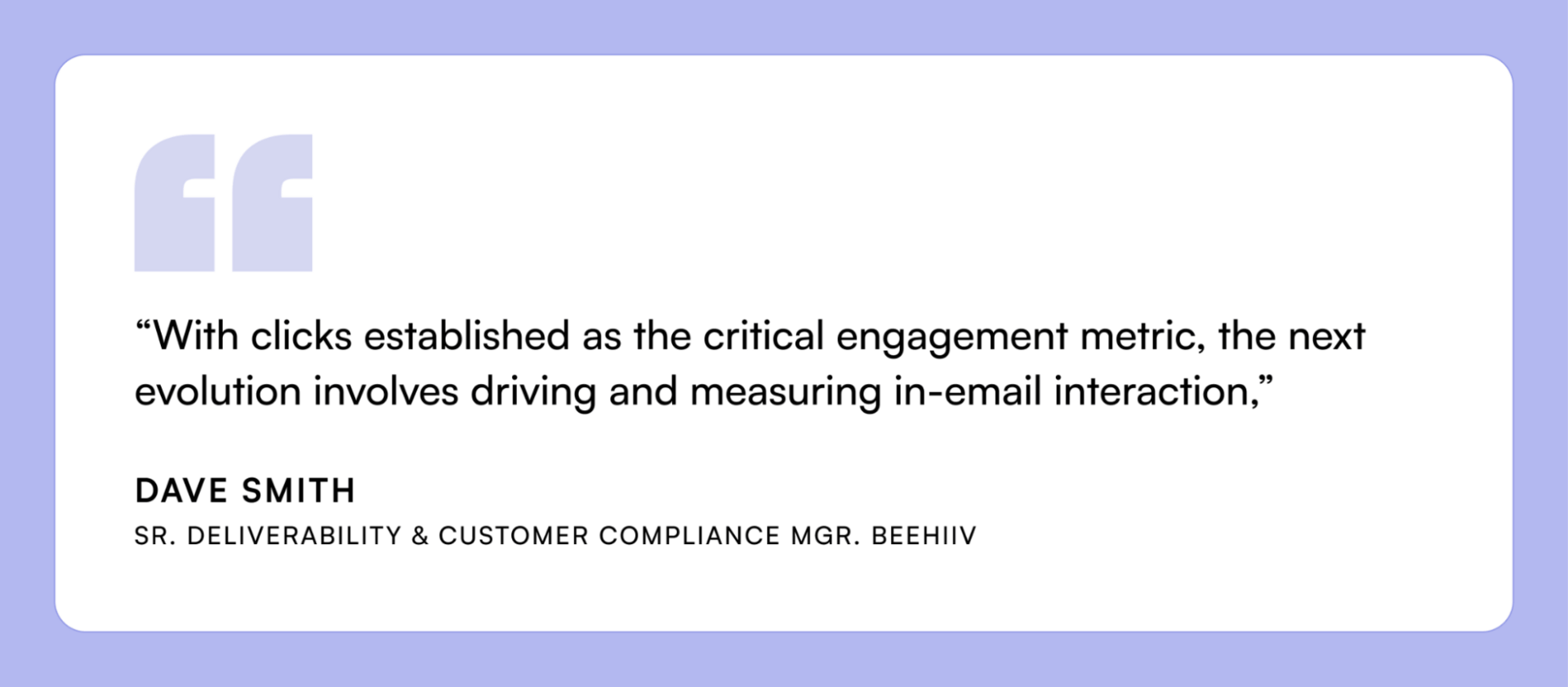
In short, reader engagement has become the new email deliverability firewall.

3. Email is one of the most reliable ways to reach your audience; more than 50% of the population checks emails daily.
Despite doomsayers calling email “old school,” it remains one of the most reliable ways to reach people.
In 2025, our data showed just how quickly newsletters can gain traction when built on owned audiences. New launches on beehiiv reached a median of 482 subscribers in their first month, proof that with the right setup, you can build momentum fast.
By the end of year one, median subscriber counts scaled to 8,314, a 17x increase driven by consistent publishing and proven growth levers.
Features like Recommendations and Boosts contributed materially to this growth. Newsletters using Recommendations grew 2.75x faster on average, while Boosts added an average of 84 subscribers per month.
Compared to social platforms, where distribution can be constrained or reversed by algorithm changes, owned audiences compound more predictably over time. Publishers that focused on a clear niche, maintained a regular publishing cadence, and invested in audience-led growth saw the strongest results.
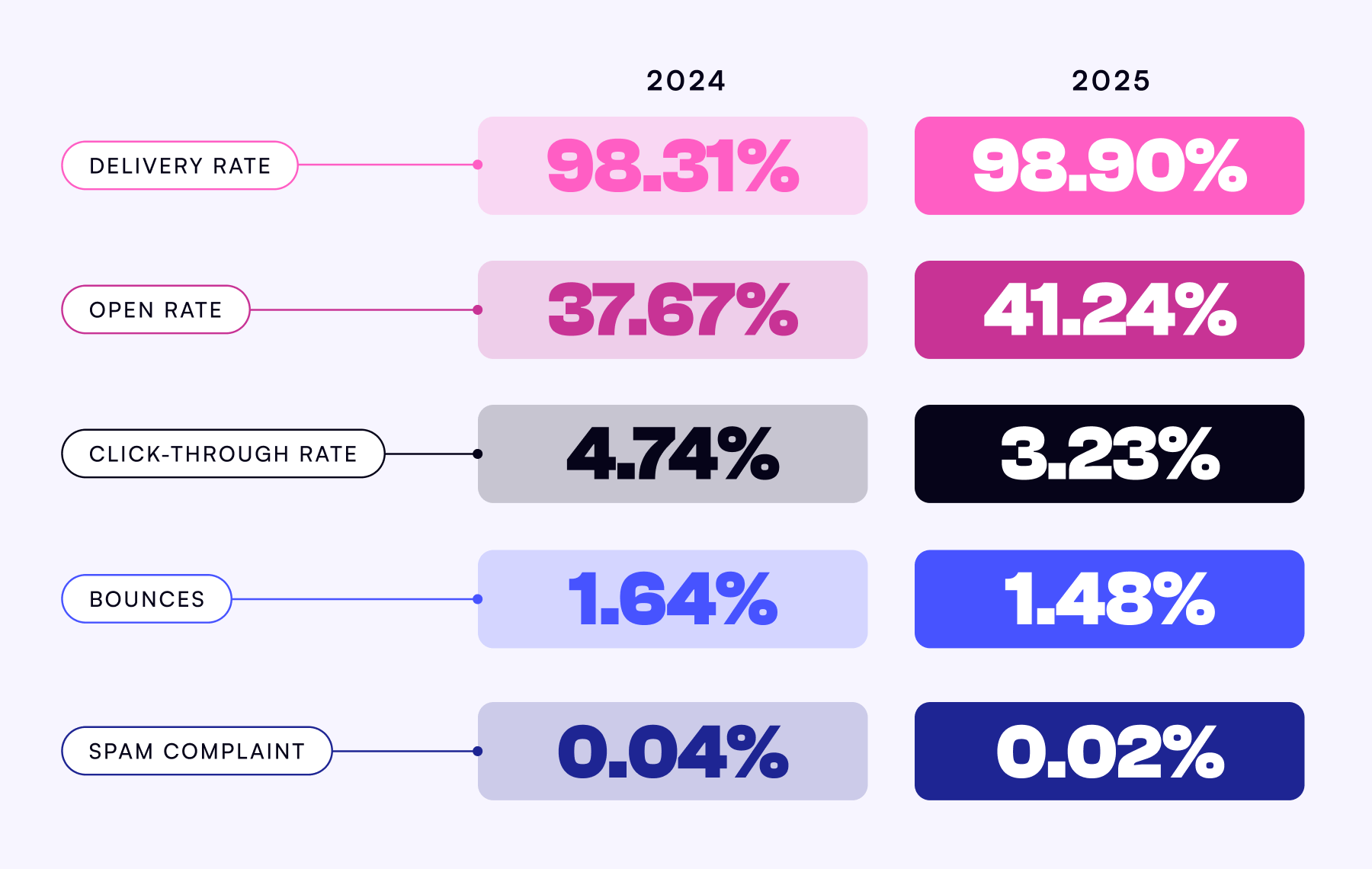
We analyzed 28 billion emails sent via beehiiv in 2025 to establish core benchmarks:

Thanks to improved sender authentication and list hygiene, nearly all messages are reaching recipients’ mailboxes.
Here’s how these benchmarks compare between 2024 and 2025:
In fact, Sung-Jae Park, Email Operations Manager at TIME, highlighted just how important list hygiene is for the media giant.

Key Takeaways:
The overall health of newsletter engagement is strong and trending upward. More newsletters are being launched, and readers are opening them at higher rates.
The open rates increased from 37.98% in 2024 to 41.24% in 2025, a sign that audiences continue to engage consistently.
CTR is down Y/Y - largely because of inbox competition. It underscores that the bar for compelling calls-to-action or engaging links is rising. It also reflects emerging behavior: readers often consume the content in the newsletter itself (especially if it’s high-quality) rather than clicking out.
An extremely low spam complaint rate (0.02%) shows that when people subscribe to a beehiiv newsletter, they generally want to be there. It’s also a testament to more sustainable growth practices (targeted acquisition, clear unsubscribe options, and valuable content that doesn’t feel spammy).
In other words, as AI makes it easier to churn out mediocre content, quality and relevance have become more important than ever for retaining an audience.
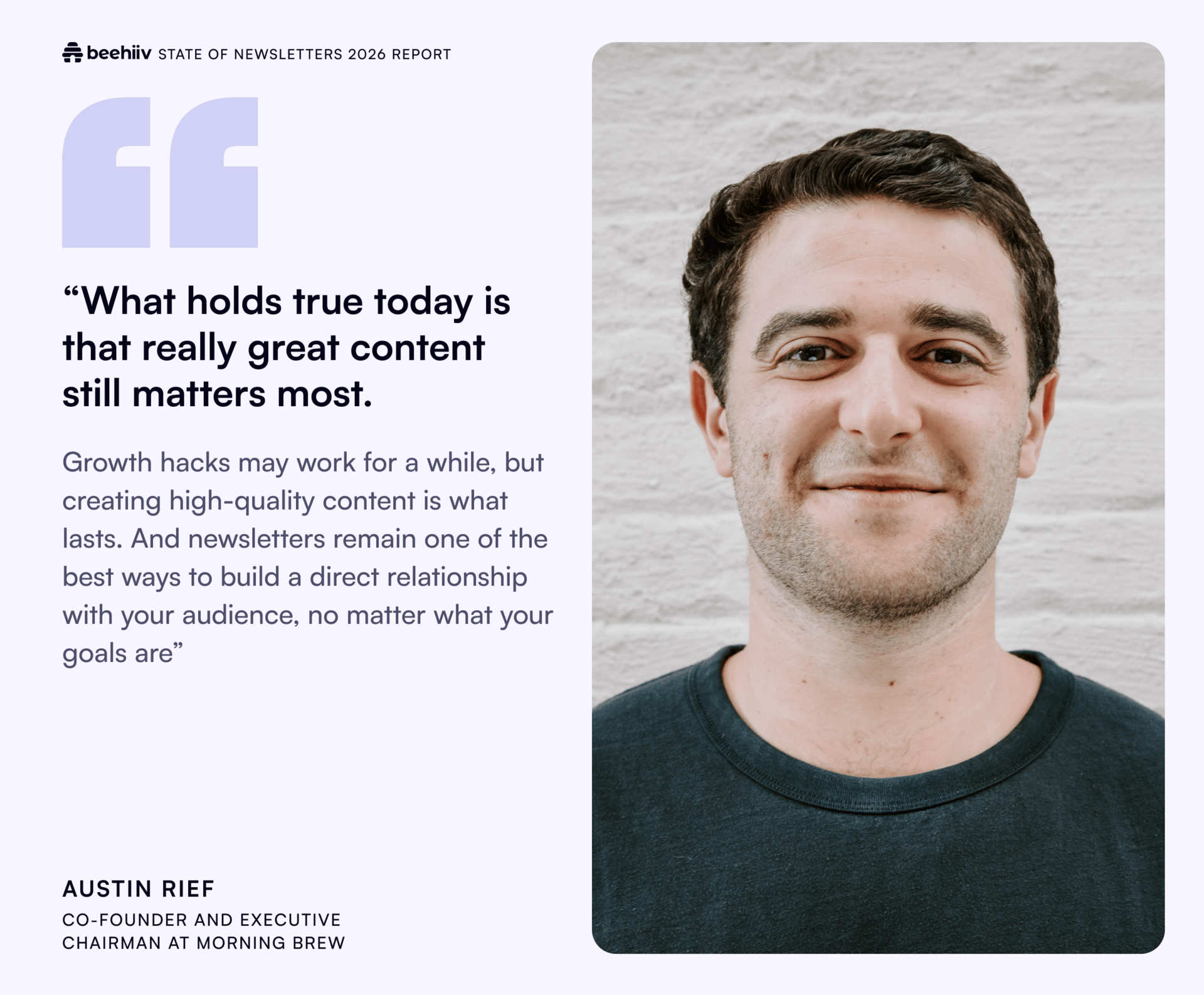
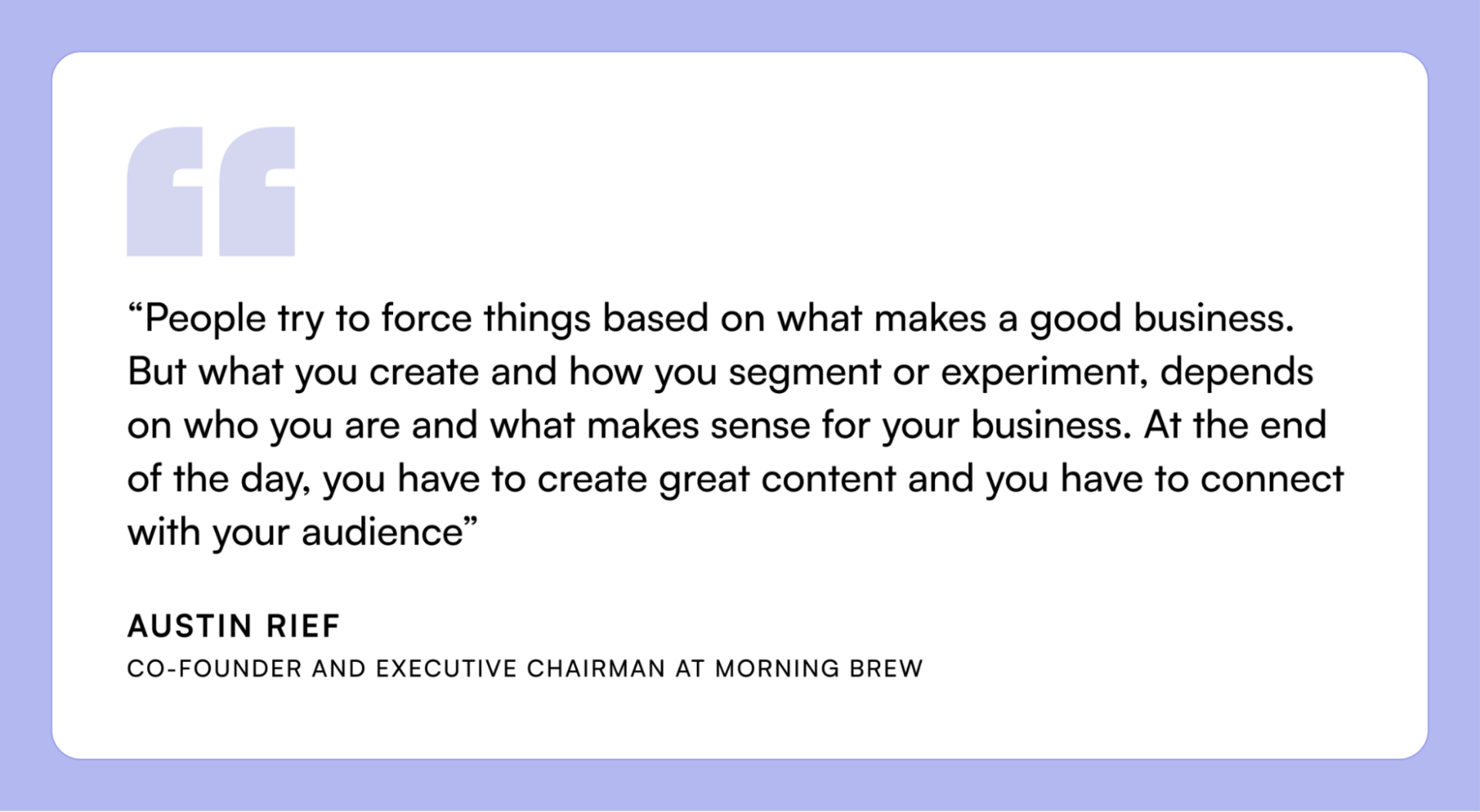
That importance is echoed by Austin Rief, Co-founder and Executive Chairman of Morning Brew, who emphasized that while tactics may evolve, content remains the foundation of long-term growth.

The average email open rate in 2025 was 41%. Yet, many newsletters on beehiiv continue to outperform industry benchmarks by extraordinary margins. The data shows a decisive shift toward passion-driven content and deep niche expertise as the primary engines of sustainable audience growth.
Readers are gravitating toward newsletters that feel personal, intentional, and rooted in identity or subject-matter depth. Categories like podcasts, history, religion, humor, film, entertainment, military, and mental health all deliver open rates far beyond the global average.
Top Performers by Open Rate (2025)
*Note: This data is based on industries that have 100+ newsletters, which we used as the baseline to ensure meaningful coverage and reliable comparisons.
Here are the top industries by open rate across all 111 categories:

These top performers exceed the global average by 10–30 percentage points – a massive spread underscoring just how much traction mission-driven, passion-oriented niches are gaining.
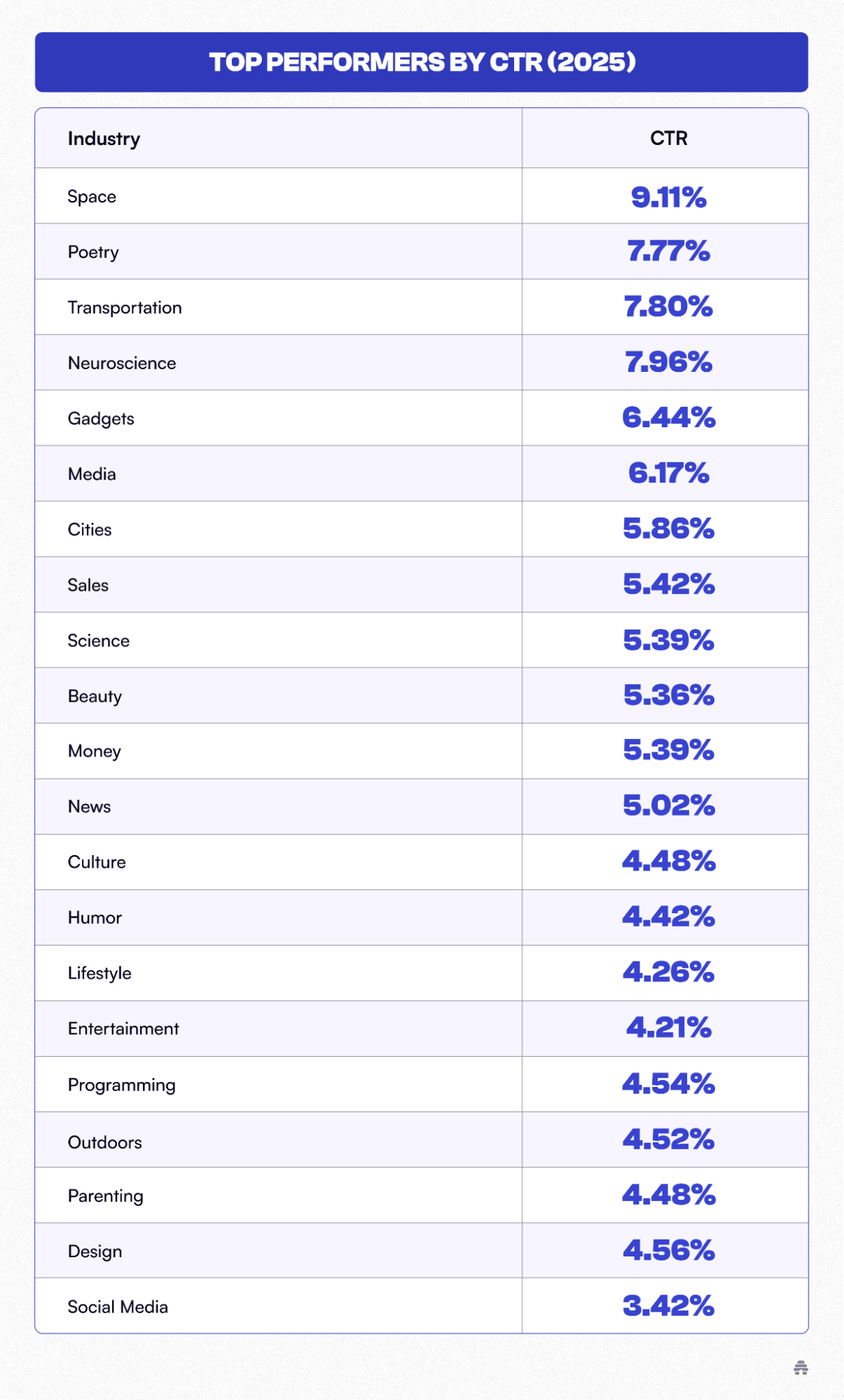
Top Performers by CTR (2025)
The click-through rate rankings highlight a slightly different set of standout categories — ones that drive not just opens, but deep engagement and reader action:
The Rise of the Content Economy
Taken together, these open-rate and CTR patterns indicate a structural shift in how newsletters create and retain value:
The content economy has arrived. Barriers to publishing have collapsed, distribution is no longer scarce, and creators are entering the market at an unprecedented pace. As a result, attention, not access, has become the most competitive resource.

But saturation doesn’t mean uniformity. In an increasingly crowded landscape, differentiation is driven less by scale and more by clarity, who the content is for, and why it exists.

In response, beehiiv continues to invest heavily in accelerating content discovery and audience growth, while encouraging creators to experiment across platforms and formats to better understand what resonates and where long-term value is created.
Key Takeaways
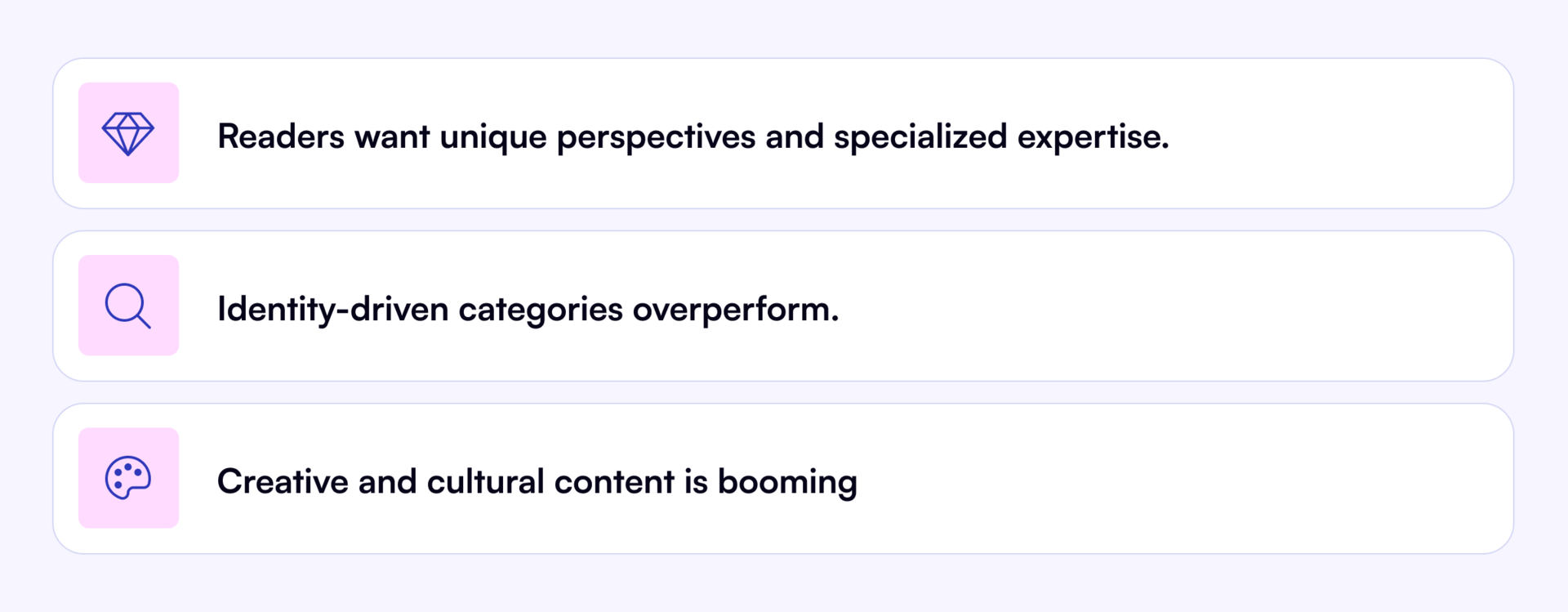
1. Readers want unique perspectives and specialized expertise.
Generalist newsletters face intense competition. But a niche like “AI tools for personal wealth growth” or “the business of VR in healthcare” has an immediate and durable audience fit.
2. Identity-driven categories overperform.
Categories tied to worldview or personal identity (think history, religion, justice) have built-in affinity loops that boost both opens and CTR.
3. Creative and cultural content is booming.
Poetry, art, photography, and niche literature categories are seeing a renaissance, likely as a counter-trend to algorithmic or AI-generated content. Readers are seeking meaning, curation, and humanity.
That shift aligns with how Austin Rief thinks about sustainable audience building. Rather than optimizing purely for scale or business mechanics, Rief argues that authenticity and audience connection remain the core differentiators.

It wasn’t just the raw numbers that changed in 2025. The strategies and channels newsletter operators used evolved in noteworthy ways.
Here are a few of the biggest trends that fueled growth last year:
The Rise of Creator-Led Media
We’ve seen countless success stories from individual creators (YouTubers, TikTokers, Twitter personalities, etc.) who have transformed their followings into thriving newsletters.
In 2025, this creator-led media boom accelerated. Why? Creators who built loyal audiences on social media realized the value of owning their distribution.
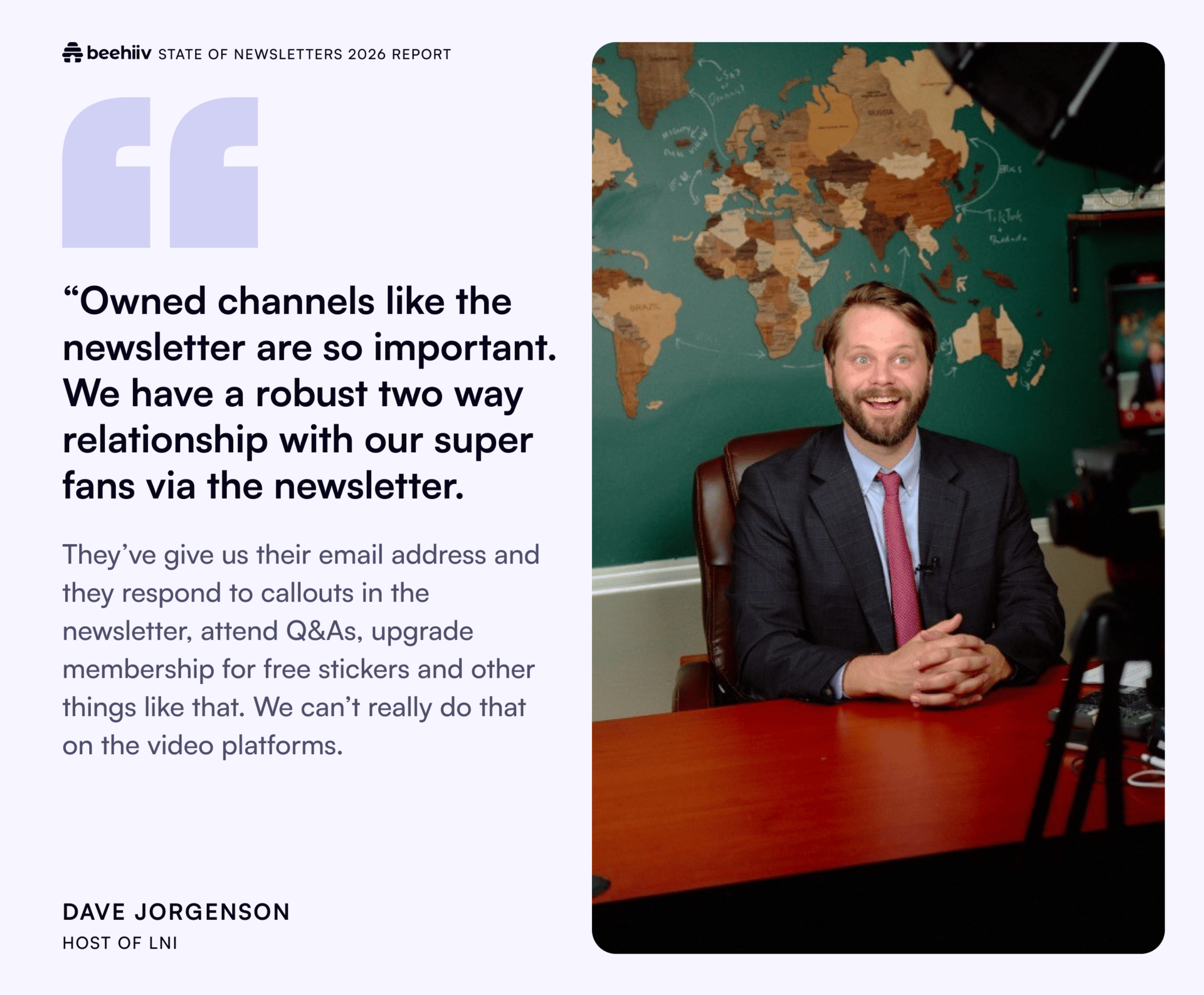
For example, LNI Media (Local News International), founded by former Washington Post TikTok star Dave Jorgenson, leveraged viral short-form video on TikTok, Instagram Reels, and YouTube Shorts to drive fans to its newsletter.
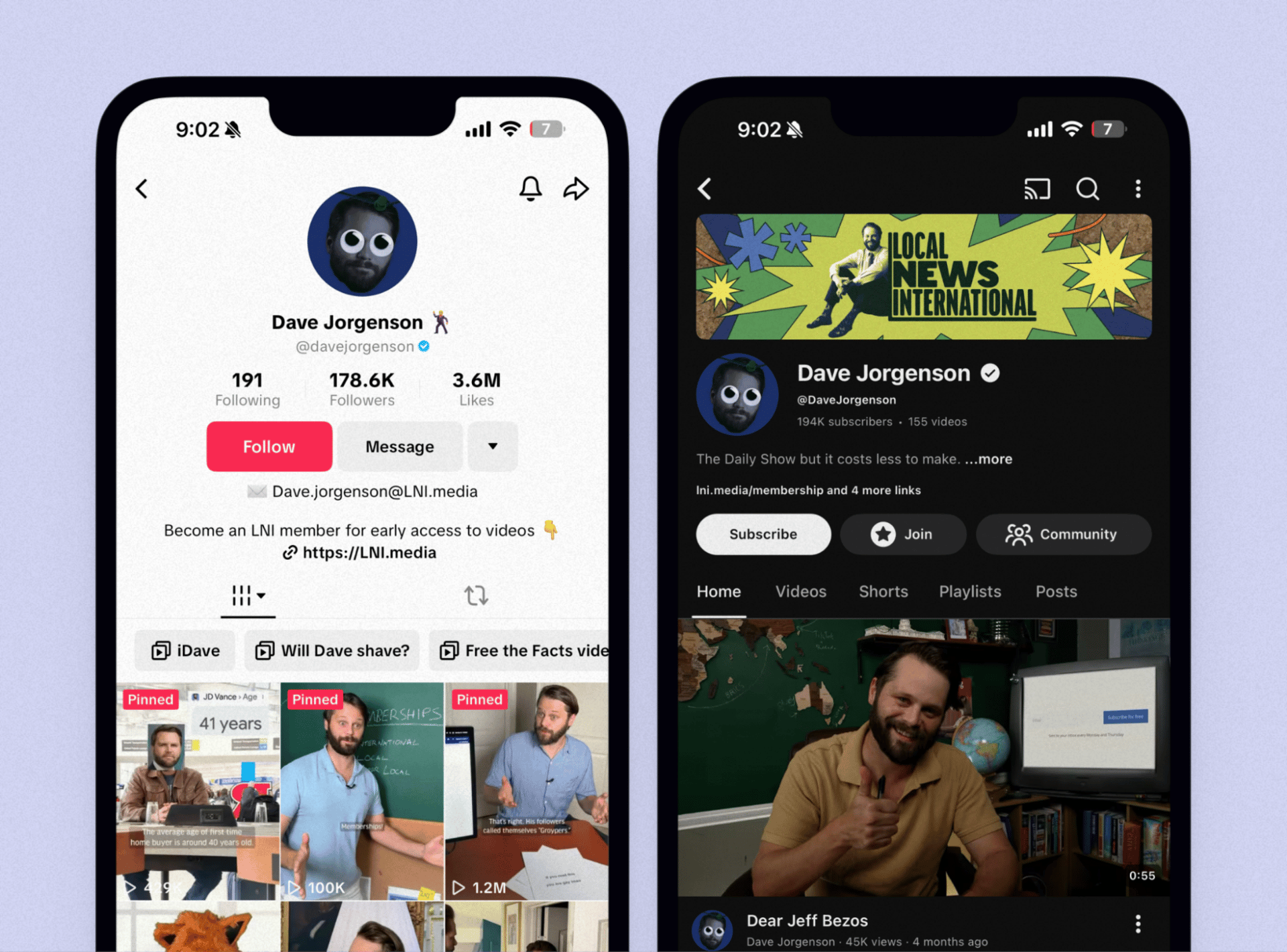
“Short-form video is our primary audience generator and has been our most effective driver of newsletter growth,” Jorgenson says.
Those social followers sign up because the newsletter offers something deeper: a direct, two-way relationship with the creator and content that isn’t constrained by 60-second video limits.
The Power of Community
Many of 2025’s breakout newsletters built more than an audience – they built a community.
Similarly, many successful creators moved from a one-way publishing mentality to a two-way engagement mindset.
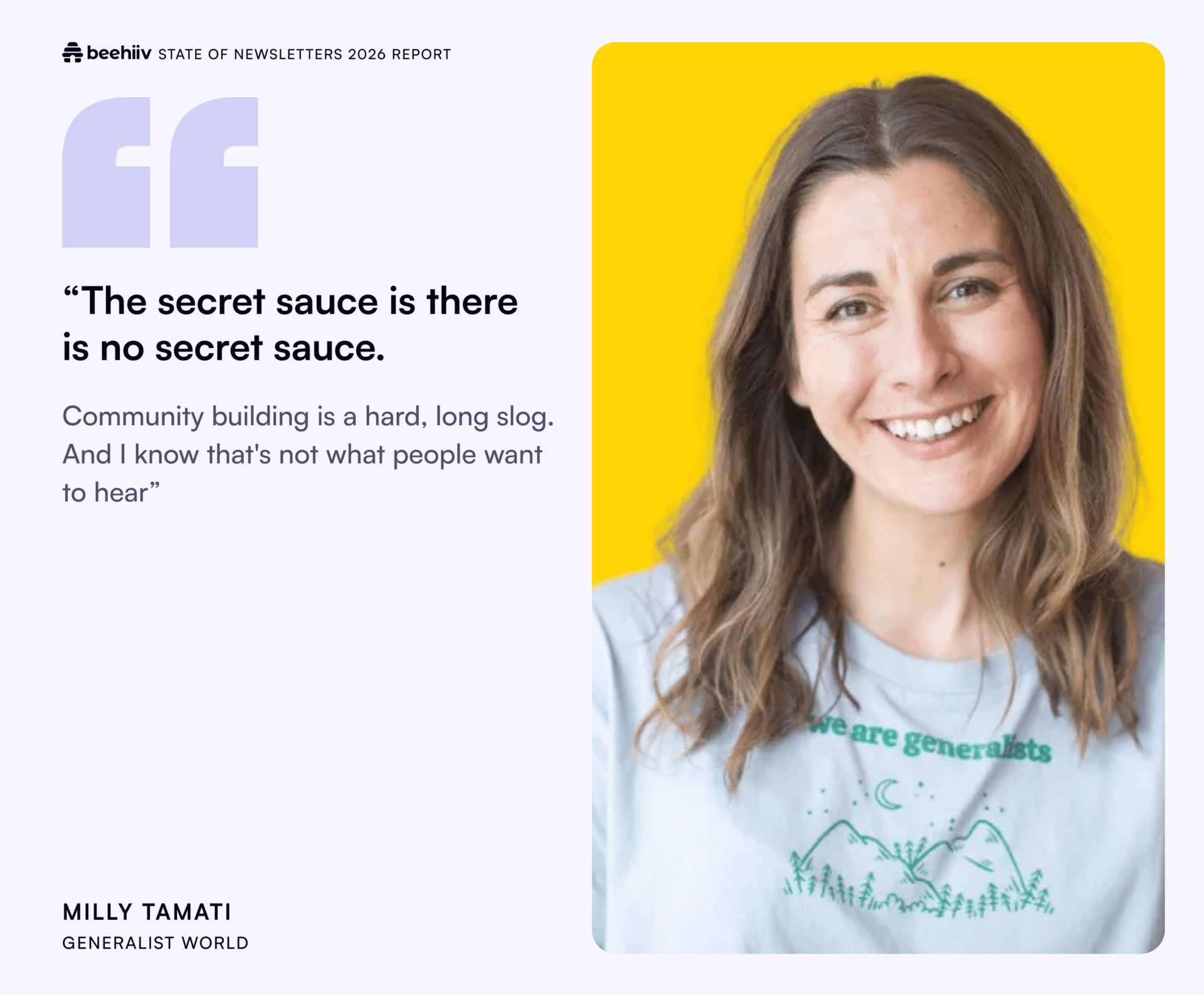
“The secret sauce is there is no secret sauce,” said Milly Tamati, Founder of Generalist World. “Community building is a hard, long slog, and I know that’s not what people want to hear.”
Tamati’s point is a reminder that durable communities are built through consistency and care, not shortcuts or rapid scaling. Longevity, she argues, comes from depth of connection rather than sheer size.
“The truth about communities is that the best ones, the ones that last for a really long time and actually change people’s lives, aren’t about scale,” Tamati added. “They aren’t about growing as many members as fast as you possibly can.”
Austin Rief emphasises that we’re “just at the beginning of community.”
On beehiiv, that belief shows up in the tools creators use to turn audiences into durable, two-way relationships. Features like subscriptions, audience segmentation, referrals, and direct email distribution give creators ownership over their audience and a direct line of communication that isn’t dependent on shifting algorithms.

Podcasts Gain New Steam
Many creators are realizing their newsletter content can be repurposed into podcasts, and vice versa, expanding their reach without a linear increase in effort.
Across the beehiiv network, podcasts are thriving. Just look at some of the top success stories:
Creator Spotlight has grown into 370K+ subscribers and a podcast with engaged, niche audience centered around the creator economy
The Girlboss team similarly launched a new podcast (“Ambition 2.0”) to provide honest, unfiltered conversations that complement their written career content
The Pour Over – the faith-based news email grew to 1.5M+ subscribers and also has a podcast that reaches 133K+ weekly listeners.
These moves not only deepen audience connection but also open new sponsorship and distribution channels. We expect this trend to continue as platforms (including beehiiv) make it easier to integrate audio.
The resurgence of local media in newsletter form continued in 2025. With local newspapers struggling or shutting down, independent newsletter operators stepped in to fill the void for city- and region-specific coverage.
Catskill Crew, for instance, grew to over 41K+ subscribers by covering the Catskills region of New York with a personal, insider touch that big media can’t replicate.
Founder Michael Kauffman treats his weekly newsletter as a foundation for a whole local brand: he’s launched limited-edition merch, a physical quarterly magazine, community events, even a membership card that unlocks perks at area businesses.
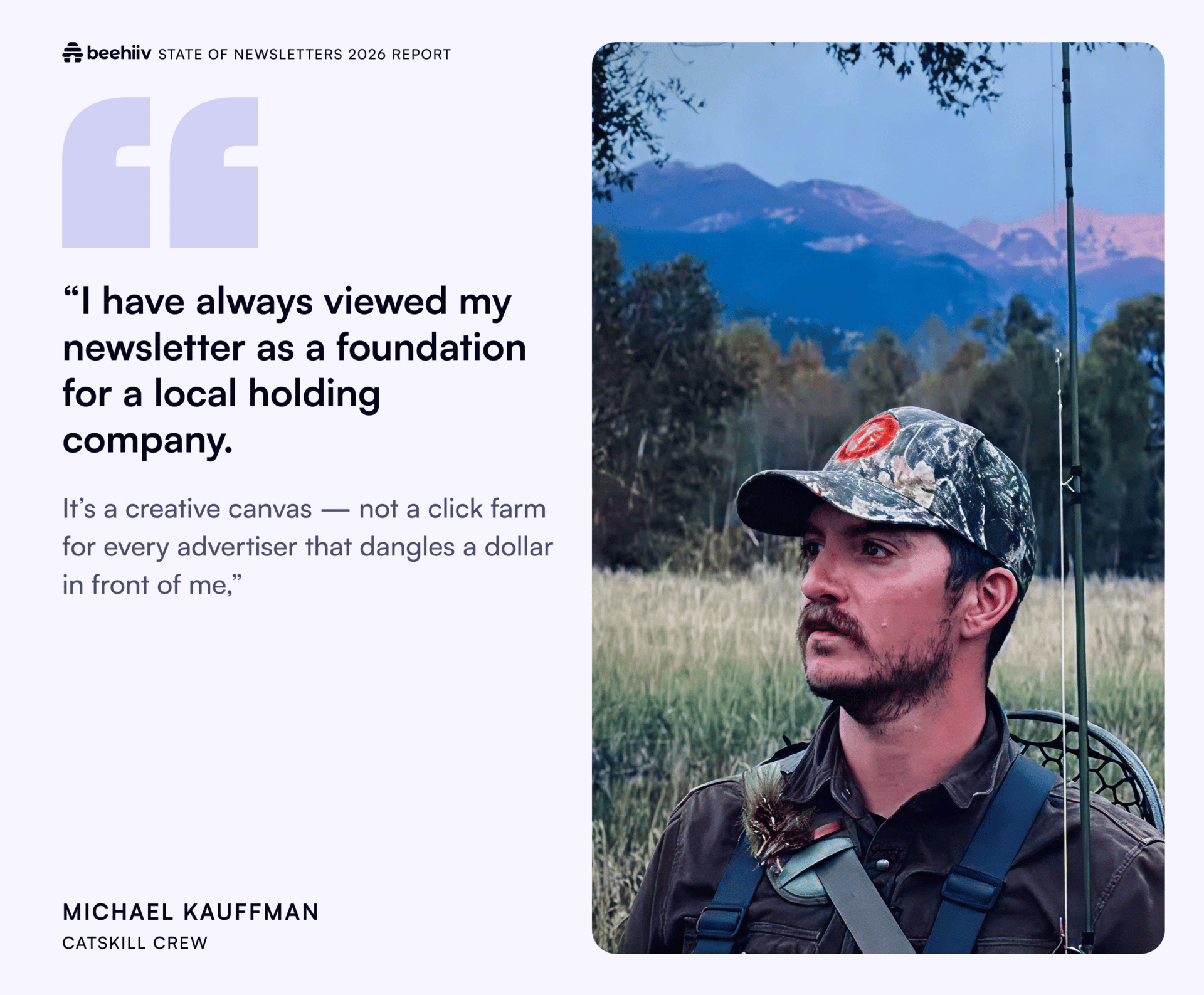
Across the board, local newsletters are seeing strong engagement because they deliver something people care about deeply: their own community. And that’s exactly how Kauffman approached his brand.

From neighborhood roundups to regional event guides, these newsletters often enjoy open rates well above 50%.
Expect to see more entrepreneurs pursuing the “local newsletter + community hub” model, as it’s proving both impactful and, with creative monetization, financially viable.

Reader behavior on beehiiv has become more predictable over the past year, and the data shows clear patterns in what drives opens, clicks, and growth.
These insights highlight how creators are timing, structuring, and optimizing their sends in 2025.
Top 3 Open Rate Changes
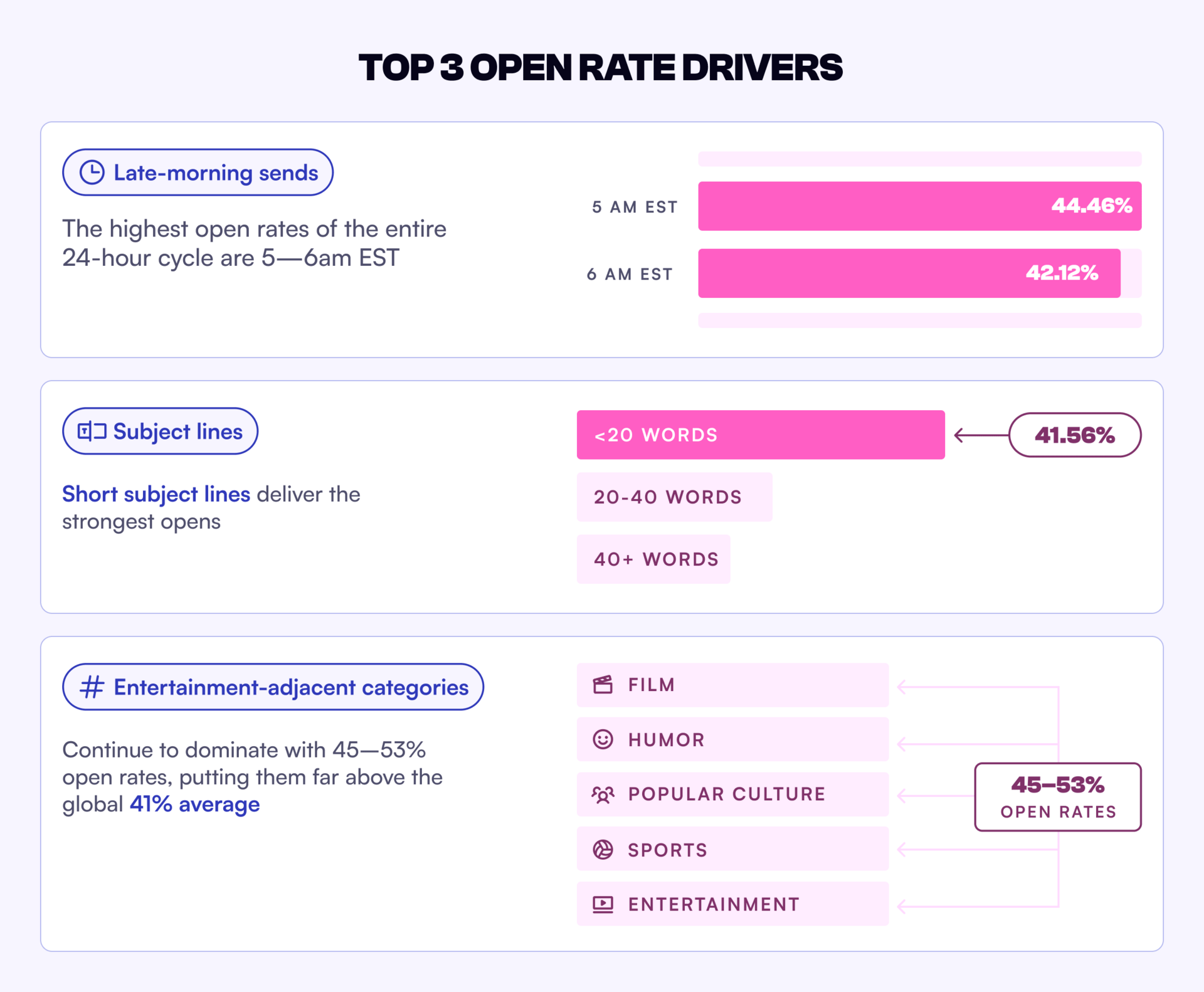
Early morning (5–6am EST) remains the top-performing window of the day, reaching 44.46% at 5am and 42.12% at 6am — the highest open rates of the entire 24-hour cycle.
Short subject lines (<20 words) again deliver the strongest opens at 41.56%, outperforming longer ones.
Entertainment-adjacent categories, including film, humor, popular culture, sports, and entertainment, continue to dominate with 45–53% open rates (well above the global average of 41%).
Top 3 CTR Trends
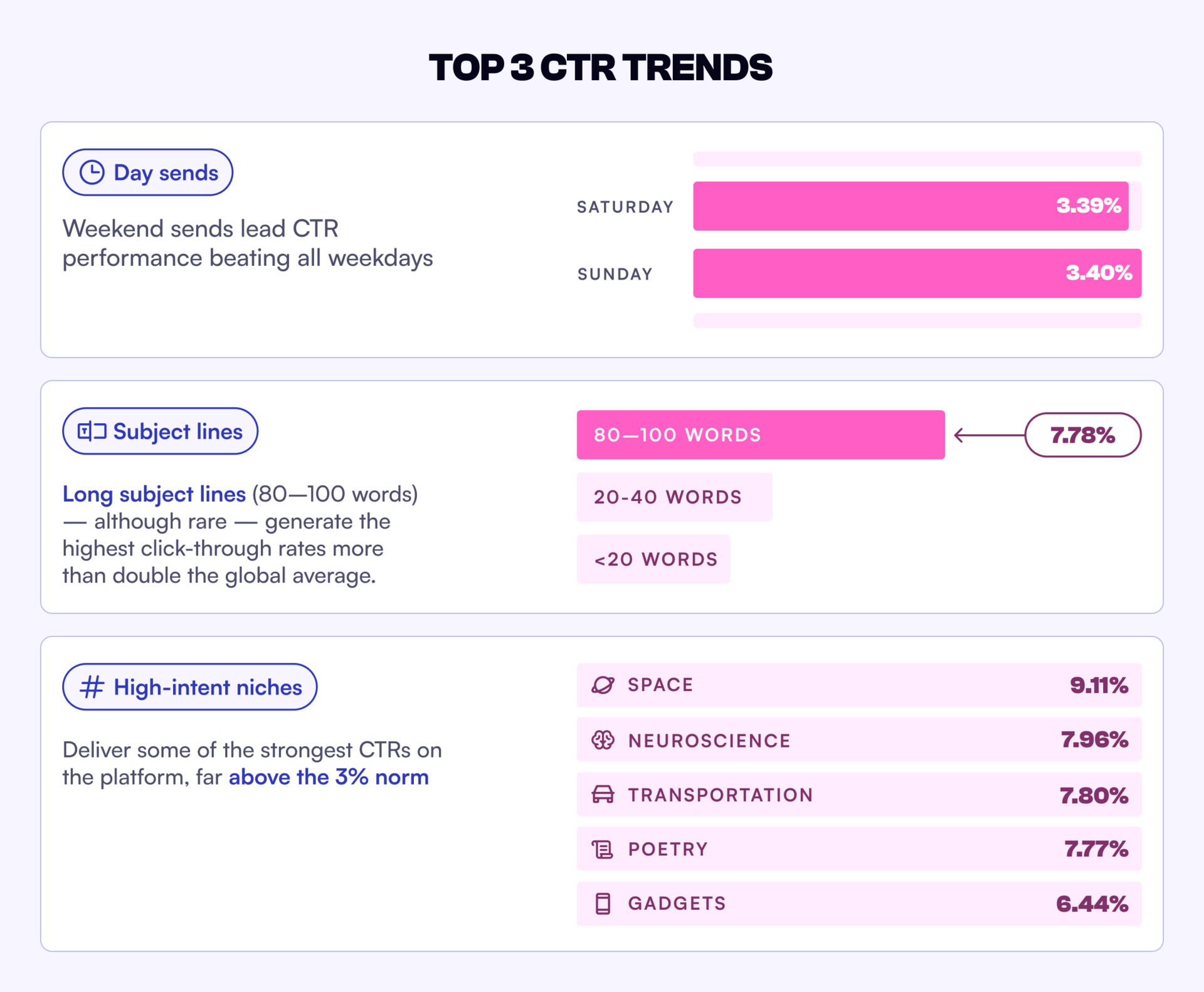
Weekend sends lead CTR performance, with Saturday (3.39%) and Sunday (3.40%) beating all weekdays.
Long subject lines (80–100 words), although rare, generate the highest click-through rates at 7.78%, more than double the global average.
High-intent niches like gadgets (6.44%), transportation (7.80%), space (9.11%), neuroscience (7.96%), and poetry (7.77%) deliver some of the strongest CTRs on the platform, far above the 3% norm.
Key Takeaways

Morning matters: the early-morning window (5–6 am EST)consistently generates the strongest opens, peaking at 44.46%.
Short subject lines win for opens (41.56%), but very long subject lines win for clicks (7.78%).
High-intent verticals still dominate CTR, with gadgets, transportation, poetry, space, and neuroscience all hitting 6–9% CTR, well above average.
Weekly cadence remains king, with 46.62% of creators sending weekly, and continues to correlate with the strongest subscriber growth.
Curation beats volume: newsletters with 3–5 meaningful, relevant links consistently outperform link-heavy digests. Readers want curation, not more noise.
When To Send: Most Engaging Times To Send Your Newsletter
Choosing when to send can be as important as what to send. Our analysis of thousands of sends in 2025 provides some guidance on timing:
What Days of the Week Have the Highest Engagement Rates?
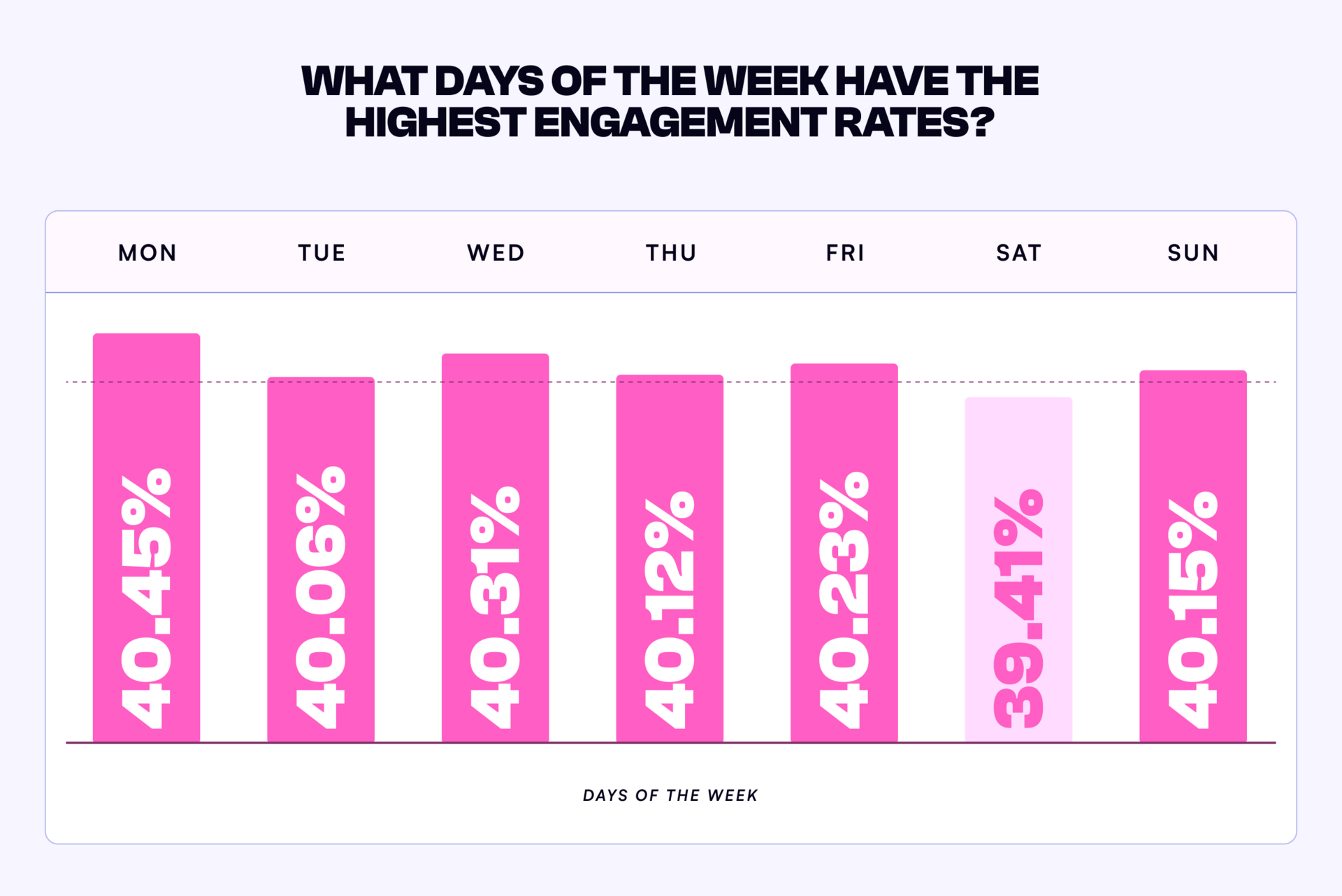
Monday leads with a 40.45% open rate, closely followed by:
Wednesday: 40.31%
Friday: 40.23%
Sunday: 40.15%
Overall, Monday through Friday are very stable, hovering in the 40% range, with only a mild dip on Saturday (39.41%).
The takeaway:
There is no single “magic” day; weekday sends all perform similarly well.
Times of the Day With the Highest Engagement Rates
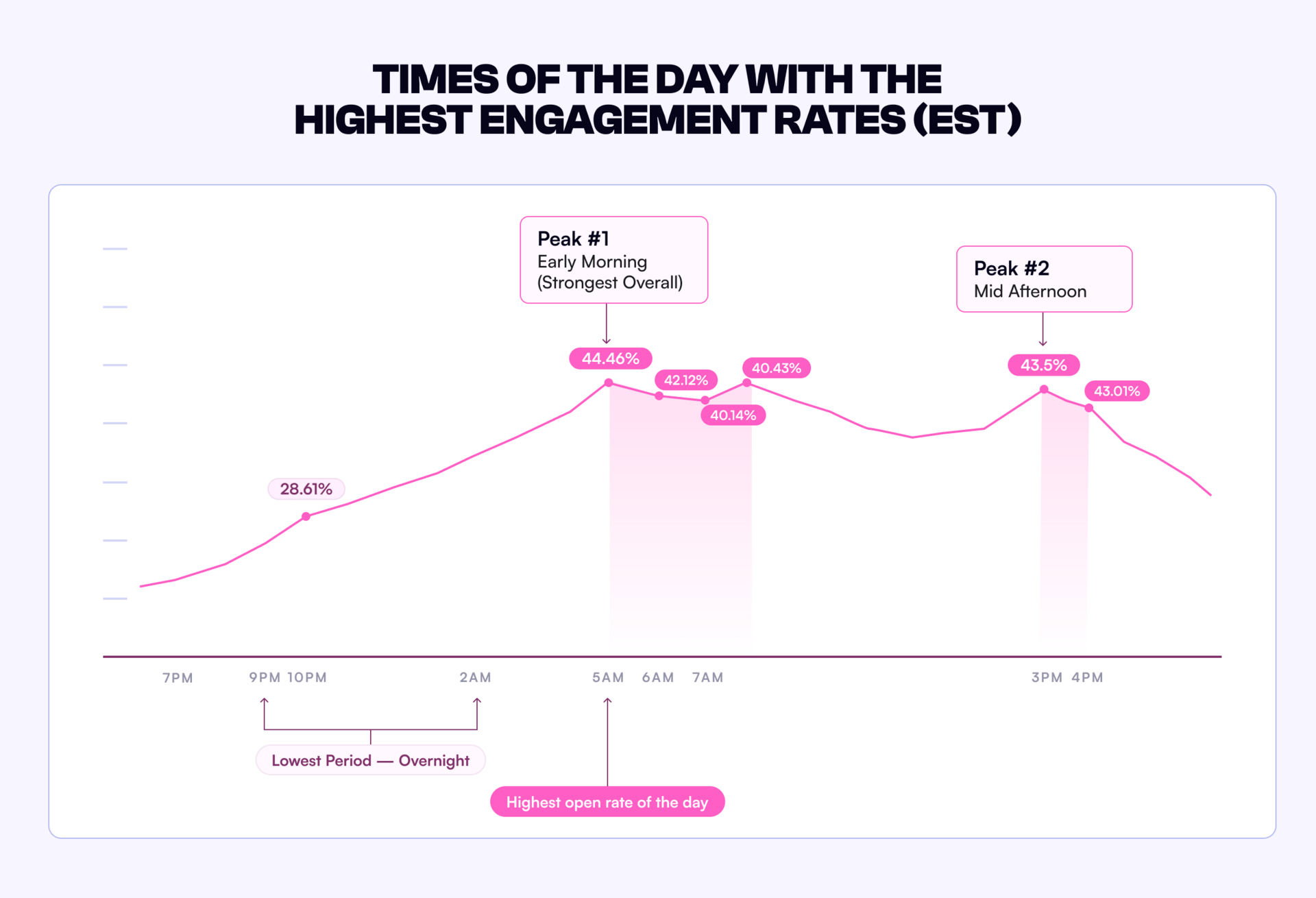
Reader attention follows a two-peak daily curve:
Reader attention follows a two-peak daily curve:
Peak #1 Early Morning (Strongest Overall)
5am EST: 44.46% (highest open rate of the day)
6am EST: 42.12%
7am EST: 40.14%
8am EST: 40.43%
Peak #2 Early Evening
3pm EST (Hour 15): 43.5%
4pm EST (Hour 16): 43.01%
Lowest Period — Overnight
Open rates fall sharply between 9pm–2am EST, hitting a low of 28.61% around 10pm EST.
Best Practice
Morning sends (localized to your audience) maximize opens — but evening reads can also perform strongly, especially for daily recaps or commentary-driven newsletters.
How Often Are Creators Sending Newsletters?
2025 send-frequency patterns:
Daily: 1.37%
Weekly: 46.67% (dominant)
Monthly: 27.15%

Weekly newsletters still strike the balance between consistency and quality, and tend to see the most predictable long-term list growth.
The most important part is to set expectations with readers and deliver on the schedule you promise, whether that’s daily or monthly.
Subject Line Engagement Stats
There is no single silver bullet, but several clear trends emerge from the data:
Short subject lines drive opens.
41.56% open rate for 0–20 word subjects
Drops sharply to 34.03%, 26.74%, and 28.62% as subject lines lengthen into 20–80 words.
Long subject lines drive clicks.
7.78% CTR for 80–100 word subject lines, more than 2.5× the global newsletter CTR.
Your niche matters more than your subject line.
Passionate audiences tend to click at 6–10%, regardless of subject line formatting.
This reinforces a key truth:
It’s more important WHO is sending the email than what the subject line says.
Emojis are widely used, but not decisive.
13.89% of subject lines include an emoji
They don’t materially raise or lower open rates, but they do help reinforce voice, tone, and personality.
Device Engagement Trends

86% of opens happen on desktop, not mobile.
This underscores newsletters as a deep-engagement medium; readers prefer larger screens for thoughtful consumption, such as during work breaks or in the evenings.
Why it matters: Design for depth. High-quality, curated content (3-5 links max) performs best here, aligning with peak engagement times (10-11am UTC sees a 44% open rate). Mobile's 14% share of opens is better suited to quick scans, so optimize preview texts and break content into clear sections.
Key Takeaway: Prioritize reader-friendly formats, embeds like polls, and ensure mobile responsiveness. beehiiv's mobile and desktop previews help test this before you send, boosting overall engagement in a multi-device world.

The path to earning revenue from newsletters has never been more accessible.
New monetization tools and strategies allow creators to start monetizing their content faster than ever.
The median time to a first dollar dropped to 66 days (about two months) for creators who launched in 2025, showing how quickly new publications can convert early traction into revenue.

“At a broader scale, I am betting on widespread consolidation in the creator and content space. That consolidation, in theory, should benefit content creators to simplify their tech stack, do more with less, and continue to scale their offerings to their audience.”
Compare that to traditional media or other platforms — it’s a testament to how quickly a newsletter can go from zero to a viable side-hustle or even full business.
Here’s how creators are using beehiiv’s core monetization tools to build sustainable income streams.
This was the year we saw breakthrough growth from paid subscriptions.
Paid subscriptions generated $19M for creators in 2025, compared to $8M in 2024.
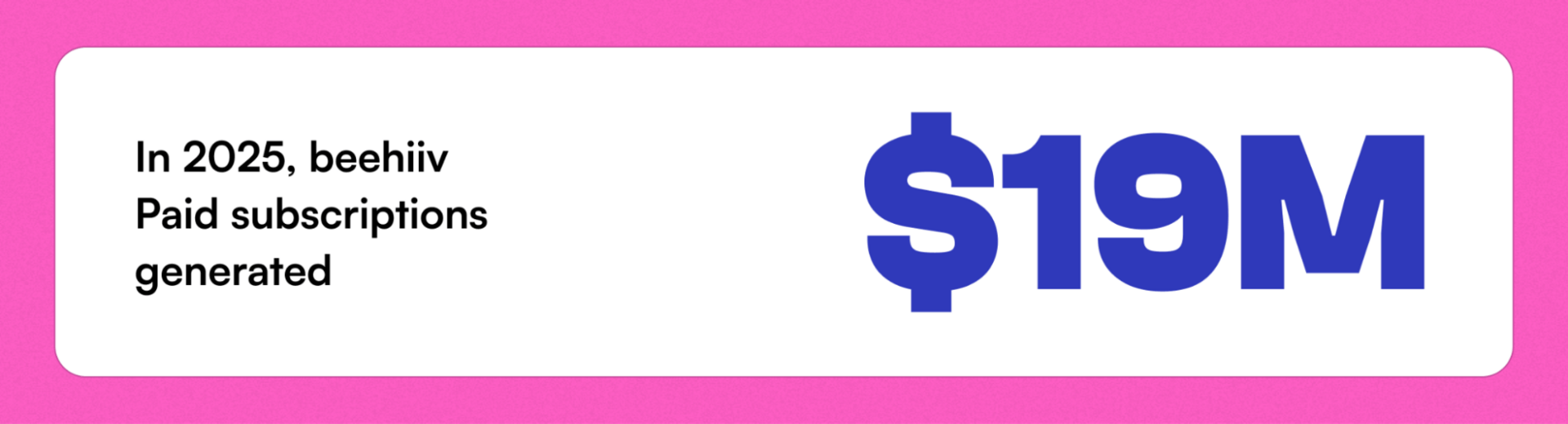
This is the strongest-performing revenue channel on the platform. It has grown 138% year over year, powered by niche creators who deliver specialized expertise.
The top earners tend to publish weekly, offer a clear transformation or utility, and use segmented content to nurture the free audience into loyal paying readers.
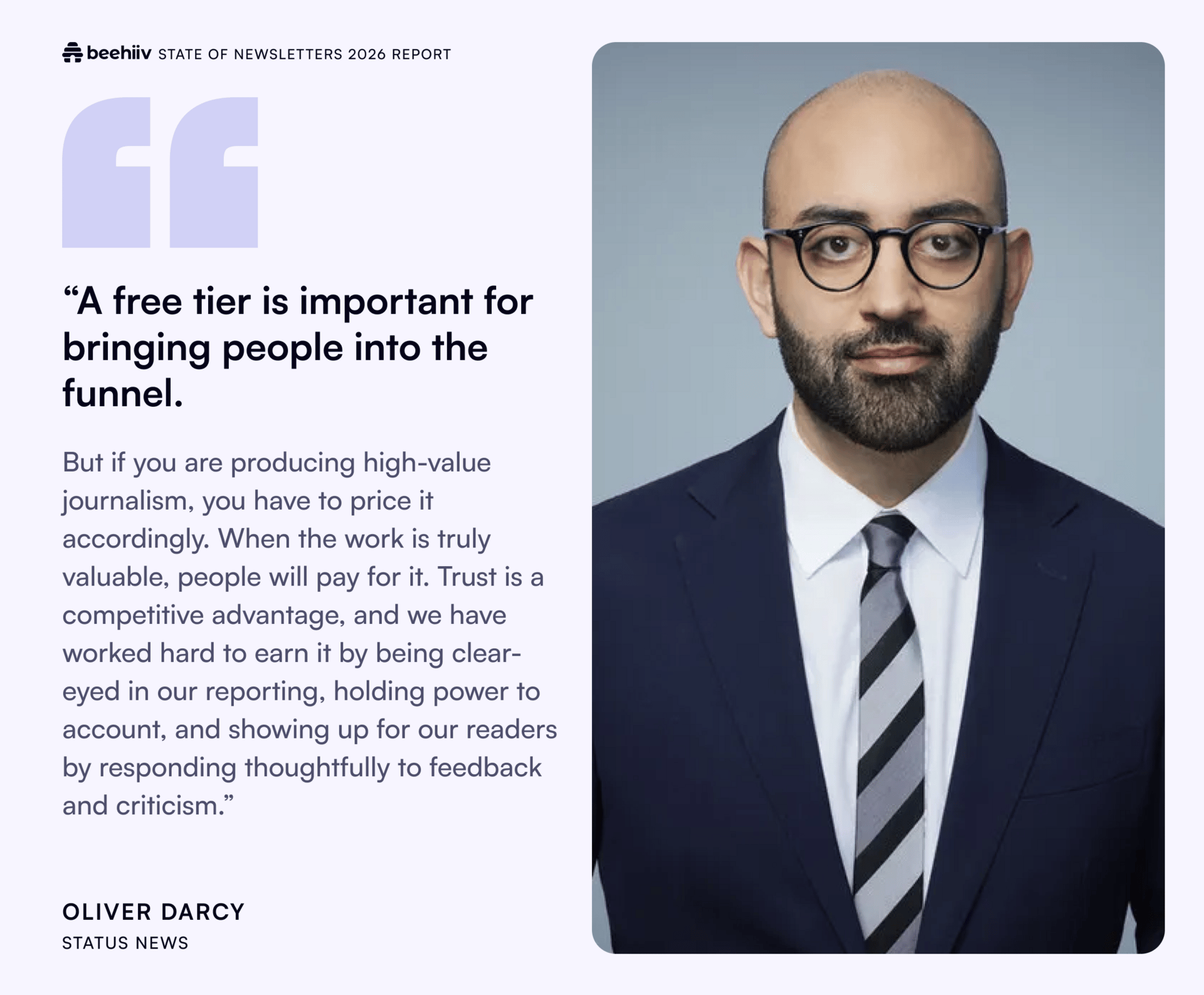
Oliver Darcy, for example, makes over $1m ARR with his media publication, Status News, enabled by beehiiv.
His advice on paid newsletters:
Advertising Via the beehiiv Ad Network

The Ad Network generated millions in revenue across thousands of newsletters in 2025, with monthly revenue totals doubling from 2024. In fact, some months saw the Ad Network contribute $1M+ to on-platform publisher earnings.
Creators are leaning on ads as a predictable baseline – especially publications with broad readership or high send volume.
Campaign quality improved significantly this year, with more targeted placements and higher fill rates. This helped publishers monetize even during slower-growth months with top-tier advertisers such as HubSpot, Roku, and Netflix.
For many publications, ads now represent their first meaningful revenue stream.
Boosts and Cross-Promotion

Boosts are becoming a key growth lever for creators who want predictable subscriber acquisition at a fixed cost.
While boosts account for 5% of total earnings, they are central to list growth: the average newsletter using Boosts gained 84 new subscribers per month directly from the feature.
For early-stage creators, this is often the fastest way to escape the plateau of organic-only growth.
Boosts reflect a broader trend of newsletter cross-pollination. Many creators found that other newsletters (not social media, not Google) could be the best source of qualified subscribers.
As The Pour Over remarked, “Our highest quality growth channels were referrals and other newsletters. They’re just harder to scale.”
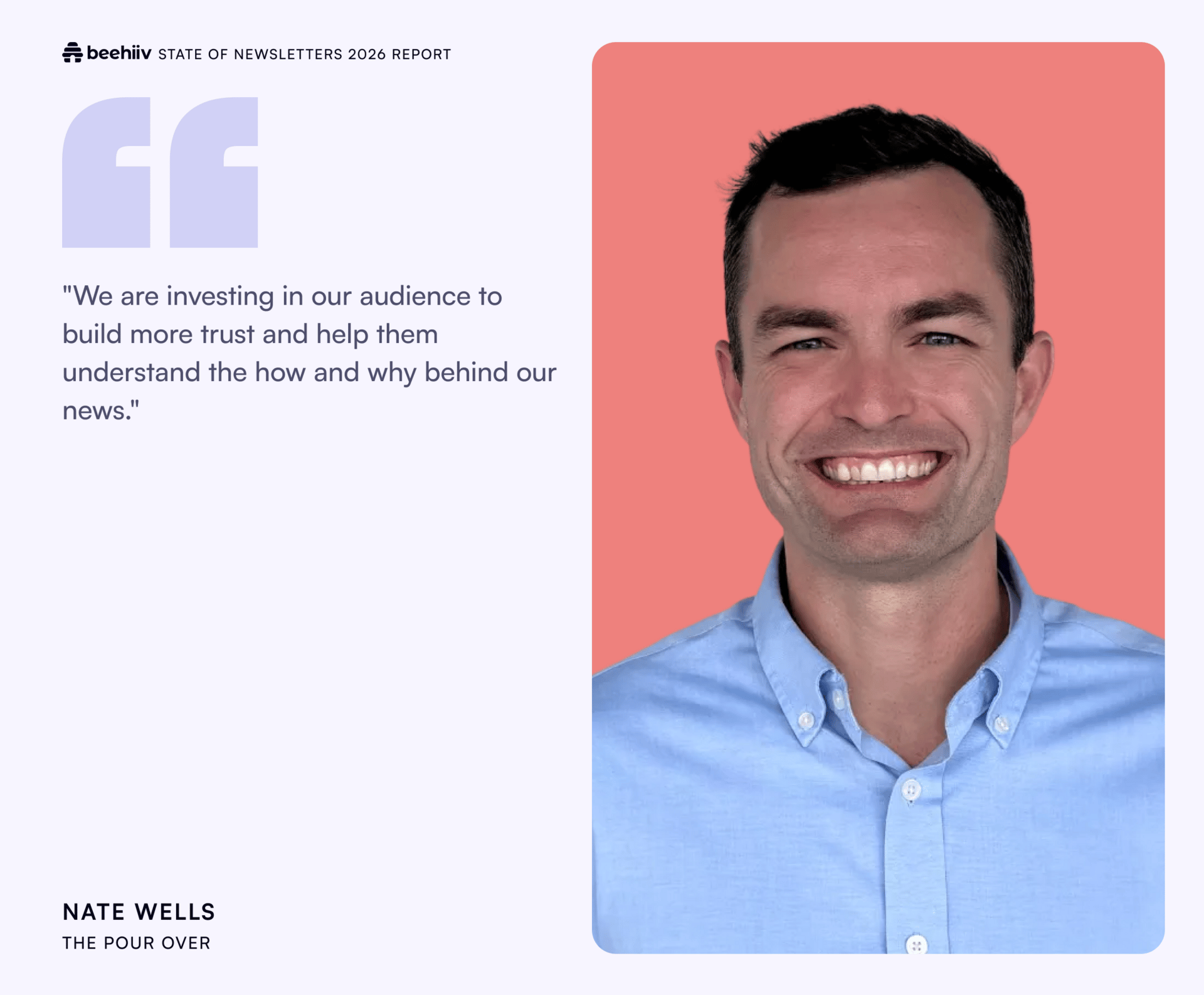
Boosts provided a way to scale it.
Recommendations

Recommendations have emerged as one of beehiiv’s most efficient growth levers because they plug into trust and intent at scale.
The Recommendation Network now includes 30,000+ active publishers and has generated millions of new subscribers.
Newsletters that participate grow 2.75x faster, and those that recommend others are 32x more likely to be recommended back.

Top 4 sits at the center of this network of reciprocity: creators spotlight four newsletters their readers will genuinely love, those picks show up right after someone subscribes, and the feedback loop strengthens as more publishers join and set recommendations.
You can see this loop in action across thousands beehiiv publications:
Just Women’s Sports has made Top 4 its fourth-largest acquisition channel this year
10Almonds has gained 1,400+ subscribers while appearing in six other Top 4 lists.
For Workspaces, Recommendations now drive 67% of new subscribers.

An added effect of the recommendations feature is its built-in reciprocity: recommending others makes you dramatically more likely to be recommended back, amplifying discovery across the network.

With the data and trends of 2025 in mind, what’s on the horizon for 2026?
We asked newsletter industry leaders and pored over the numbers to make some predictions about the year ahead.
In 2026, newsletters will look less like one-off publications and more like fully-fledged media hubs, anchoring communities, digital products, life events, and entire ecosystems.
We’ve already seen countless beehiiv publishers run this playbook, turning an email audience into podcasts, websites, communities, and more.
Ryan Broderick’s Garbage Day, for example, expanded from a one-person email into a 100K+ subscriber media business that now includes a spin-off podcast and a staff of two.

In Broderick’s own words, “After moving to beehiiv, I feel like I went from someone who just writes newsletters to someone who is building a real and sustainable media business.”
This transformation – from newsletter to “media hub” – is a path we expect many creators to follow in 2026.
Even media brands like TIME and TechCrunch are using newsletters as the core of multi-channel strategy.

2. The creators who grow the most will prioritize community.
2026 will be the year of deeper engagement and community. Nearly every operator we spoke with is shifting from pure growth to retention, loyalty, and two-way interaction. Community doesn’t have to mean Discord servers or meetups, but it does mean treating readers as participants – not passive subscribers.
Half Baked illustrates this shift. After passing 130,000 subscribers in a year, the team doubled down on community depth. Their biggest campaign was the Half Baked x Bolt Founder Hackathon, which drew 15,000 registrants and thousands of applications. “It perfectly captured what Half Baked is all about—activating founders, not just inspiring them," says co-founder John O’Keeffe.

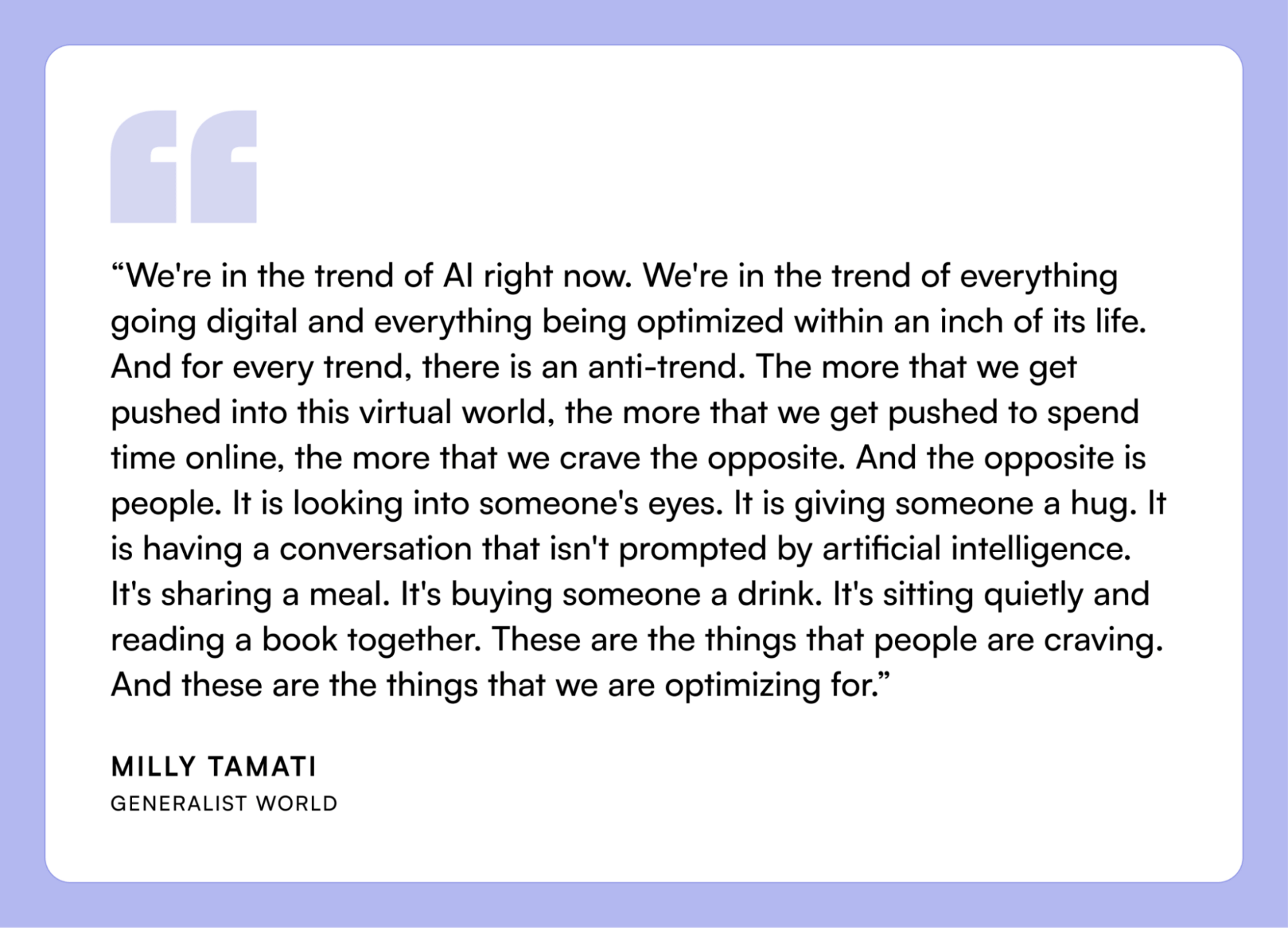
Generalist World provides another blueprint for community-centric growth. Founder Milly Tamati built a global community for “squiggly-career” professionals by funneling readers through a fun quiz and into a membership.
Her five-minute “Generalist Scorecard” quiz went viral on TikTok, helping to drive thousands of newsletter subscribers.

But Tamati didn’t stop at the inbox; new subscribers are invited to join forums, events, and even contribute content.
By prioritizing interaction and user-generated content, Generalist World turned a one-way publication into a living community of 43,000 newsletter subscribers and 700+ paying members collaborating on career growth.
Many beehiiv publishers similarly refer to their audience as a community rather than just readers.
Girlboss, which runs a popular daily women’s career newsletter, explicitly cultivates a “dedicated community” of ~110,000 active subscribers.

They keep content conversational and relevant to readers’ real needs, even dedicating one day a week to spotlight members of the community (“Feedback Thursday”) and answer reader questions.
“We’ll always ask our readers first…we’re doing it for them,” says Executive Editor Victoria Christie, emphasizing how reader feedback shapes Girlboss Daily. This reader-first approach has paid off in consistent open rates and a loyal, growing fanbase.
Founders are recognizing that an active 10,000-member community can be more valuable than 100,000 passive readers.
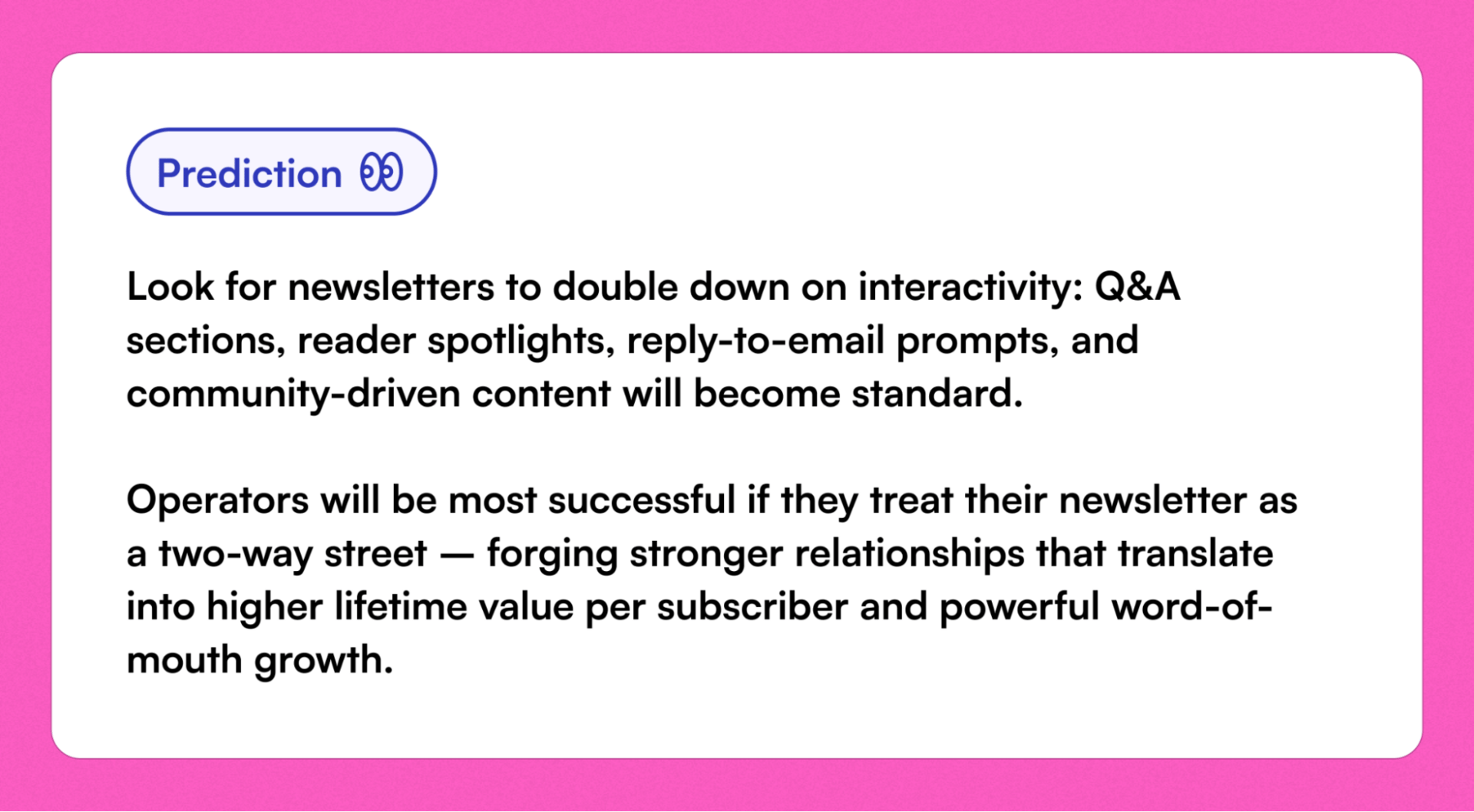
Prediction: Look for newsletters to double down on interactivity: Q&A sections, reader spotlights, reply-to-email prompts, and community-driven content will become standard.
Operators will be most successful if they treat their newsletter as a two-way street, forging stronger relationships that translate into higher lifetime value per subscriber and powerful word-of-mouth growth.
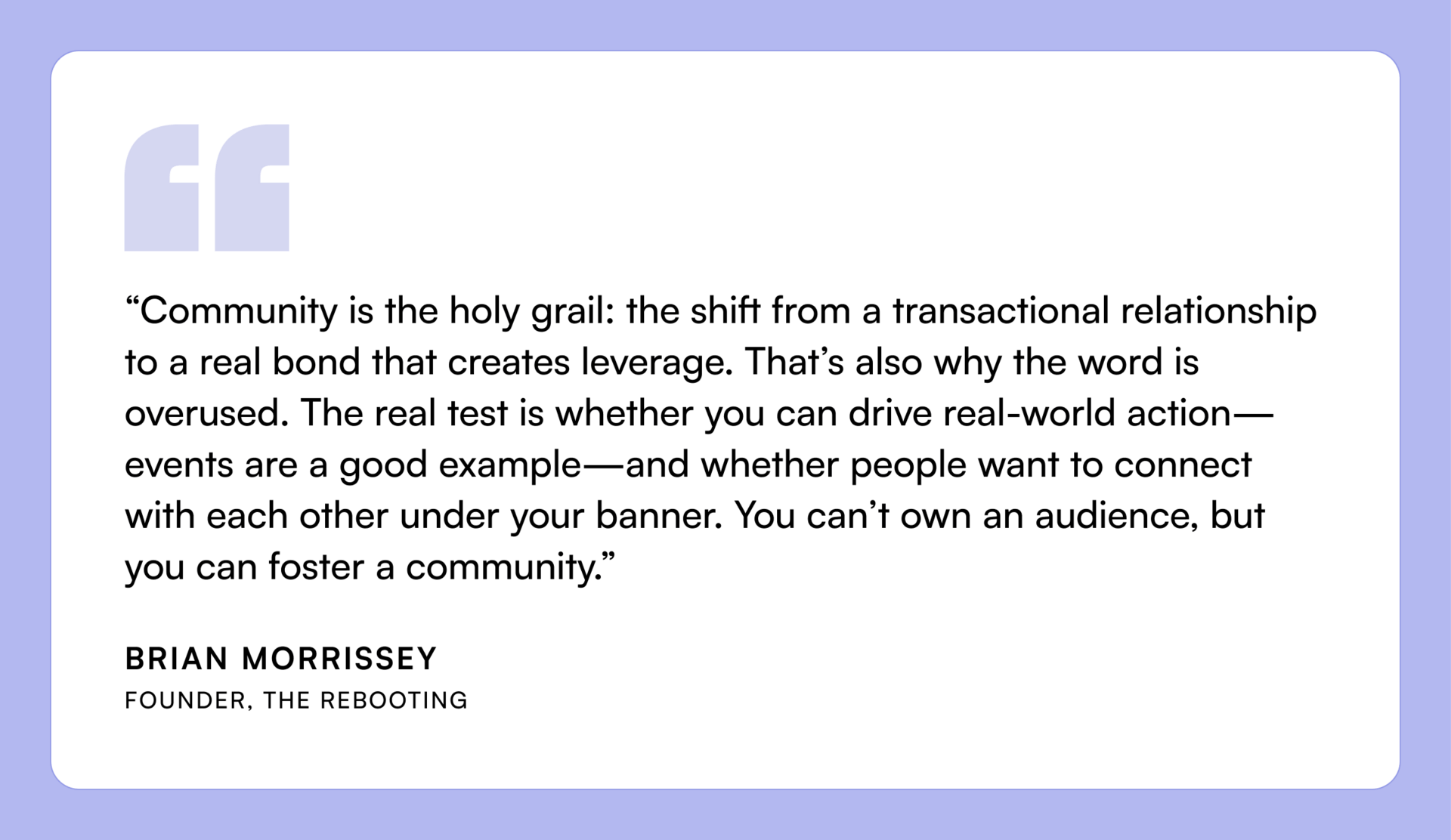
Brian Morrissey, the founder and writer of The Rebooting, had a similar thought to share:

3. Events and IRL are one of the biggest opportunities.
As more of our daily lives take place online and are moderated through algorithms, successful newsletter brands are finding ways to bring their communities together in real life.
Offline events – from casual meetups to full-blown conferences – create a level of intimacy and loyalty that even the best email content can’t match.
2025 provided glimpses of this trend, and we anticipate 2026 will elevate “IRL” to a key strategy for community-driven newsletters.
We’re seeing it across:
Creator meetups popping up in major cities
Niche coworking days driven by newsletters
Founder dinners, pitch nights, hackathons, and local accelerators
Community-led summits that feel more like reunions than conferences
Hybrid digital + IRL cohorts focused on shared goals
Newsletters like Generalist World, Catskill Crew, and Creator Economy NYC have all started hosting local meetups, dinners, and workshops for their readers.

The founders of Half Baked hinted that their next move is partnering with brands to host founder meetups, hackathons, and even startup accelerators aligned with their mission of supporting early-stage founders. Extending the brand into physical events helps turn existing readers into a close-knit network and also attracts new ones.
Other newsletters are already leveraging real-world moments. Just Women’s Sports times its biggest subscription pushes around major sports events, launching giveaways during the Women’s World Cup or NCAA Final Four. Prizes like game tickets and signed merch create strong incentives to subscribe, and these subscribers stick: 96% of people acquired through event-themed giveaways stayed on the list a year later.
This approach turns live-event energy into newsletter engagement, and we expect more creators to follow suit — from tech newsletters tying campaigns to CES to founder dinners at SXSW.
Prediction: Live events will become a major extension of newsletter brands in 2026. Expect creator-hosted meetups, workshops, and multi-day conferences where newsletters act as funnels for ticket sales and as the community glue that keeps people connected before and after the event.

4. AI-driven personalization and higher rates of automation adoption.
In 2026, the gap will widen between creators who embrace AI tools/automation and those who don’t.
But importantly, this isn’t about AI replacing human writing (in fact, that’s generally a losing strategy – more on that in a moment).
It’s about AI augmenting how you target, optimize, and even create ancillary content, and about automation scaling your efforts.
Here’s where AI and automation are making the biggest impact:
Smarter content distribution: A big area of promise is using AI to optimize who gets what content. For instance, newsletters can deploy algorithms to automatically send emails at the optimal time for each user based on their past behavior (if subscriber A always opens at 6am and subscriber B at 9pm, why send at a suboptimal time for one of them?).
AI can also help segment audiences by interest. beehiiv’s team saw an 82% boost in email conversion rates when using AI to personalize content recommendations.
Publishers who mine their first-party data (or even collect simple survey responses) and use AI tools to act on it will deliver more relevant newsletters, driving better engagement.
Automation of tedious tasks: A lot of newsletter growth and retention tactics can be automated — and should be. Welcome emails, re-engagement campaigns for lapsed readers, drip sequences that deliver a course or onboarding info, etc., can all run in the background once set up. Yet, many creators haven’t taken the plunge. By some estimates, over 80% of independent newsletters aren’t using any automation beyond a basic welcome email. That’s a huge opportunity.
In 2026, top newsletters will automate wherever possible — not to remove the human element, but to free up time for creators to do what only they can do: create great content and engage with the community.
AI-assisted content (with a human touch): Some newsletter operators are using AI text generators (like GPT-4) carefully for initial drafts, idea generation, or summarizing research. But there’s a near-universal agreement among seasoned writers that the final content should be human.
Newsletters that become “AI slop” will suffer; those that use AI to level up speed, while doubling down on authenticity, will thrive.
Analytics and insight generation: Another underutilized area is using AI to support deeper analytics. Not everyone is a data analyst, but now you don’t have to be.
You can feed your newsletter stats into an AI assistant and ask questions like “which subject lines had the highest click to open rate?” or “what was my best day of the week last year for signups?”
AI can surface insights that would take hours to uncover in Excel. Embracing these tools will be like having an analyst at your side, identifying engagement patterns you can act on.
Case Study: There’s An AI For That

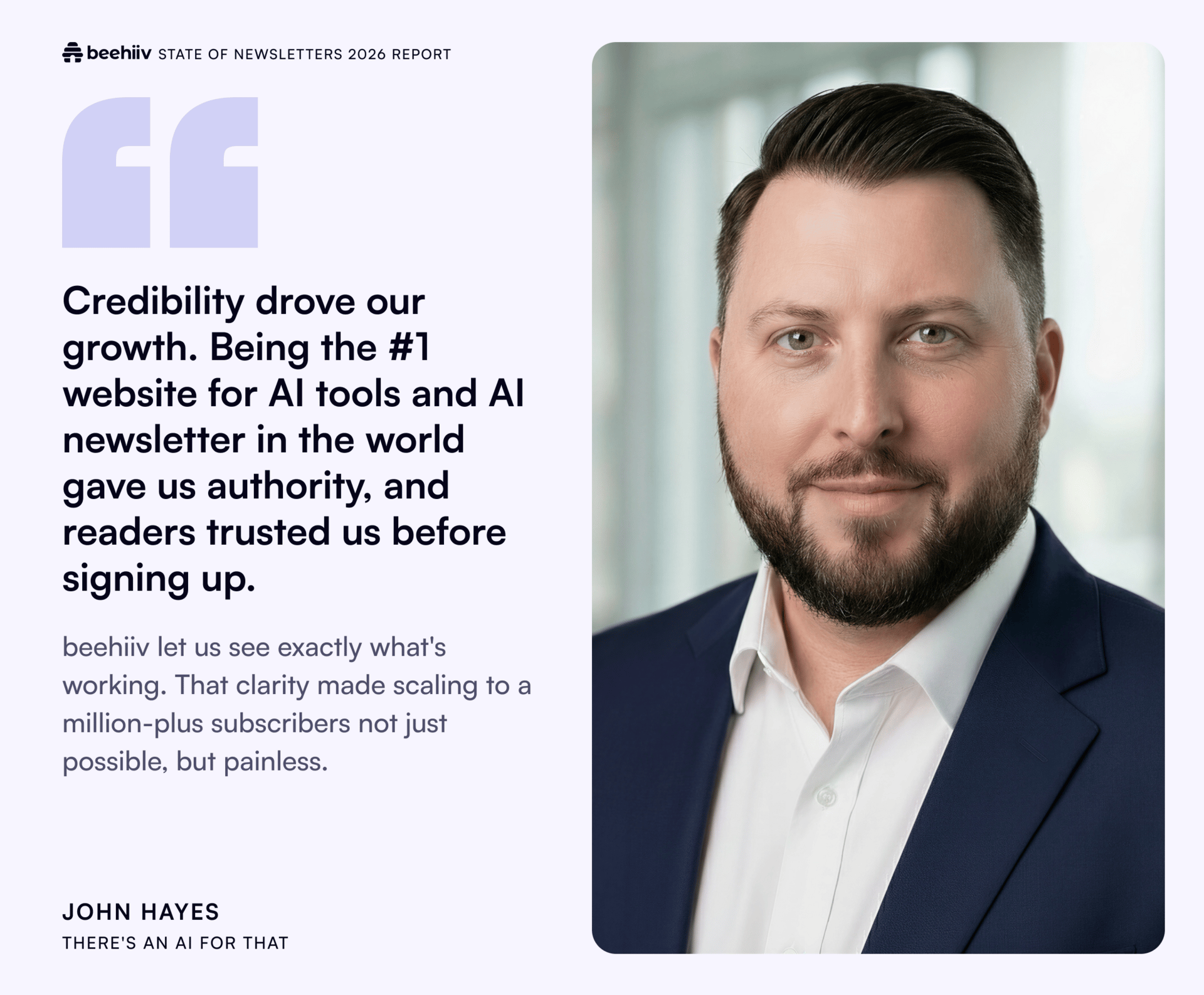
“There’s An AI For That,” the world’s largest AI-focused newsletter, provides a striking example. In under 2 years, it rocketed to 1.7 million subscribers with $0 in ad spend.
Founder Andrei Nedelcu initially generated issues with AI. As the newsletter grew, John Hayes was brought on to lead content: curating, writing, and editing each issue. AI still assisted with research and discovery, but editorial decisions were all human. That human layer is how trust was maintained.
The team leveraged beehiiv’s analytics and segmentation to continually optimize and gear content for readers based on interests.
This behavior-based customization, along with a shift from thrice-weekly to daily sending to boost engagement, drove open rates to an impressive 55%.
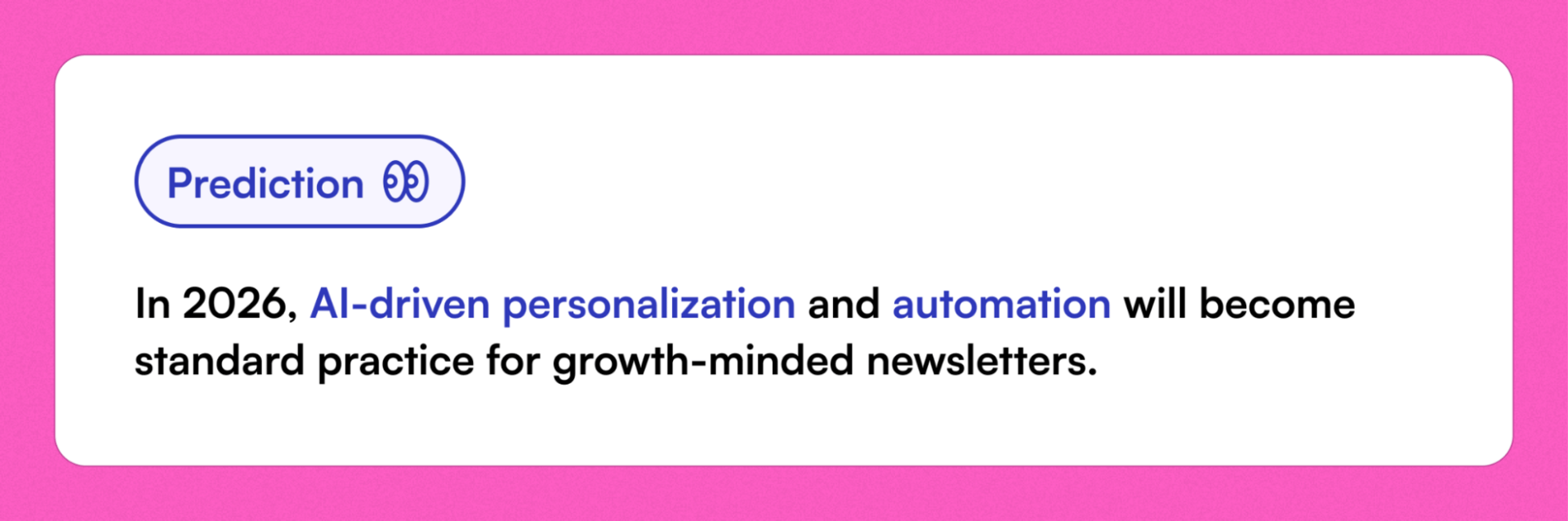
Prediction: In 2026, AI-driven personalization and automation will become standard practice for growth-minded newsletters.
The top operators will use AI to tailor content to subscriber segments (for example, a finance newsletter might automatically serve more crypto stories to readers who clicked on past crypto articles, while others see more general stock market news).
Onboarding sequences will get smarter, with new subscribers receiving different welcome emails depending on how they signed up or what topics interest them.
We also expect automated cross-channel syndication (e.g., turning a newsletter issue into social posts, or vice versa) to save creators time and keep audiences engaged across every platform.
Newsletter creators who act like product builders, iterating with data and automating where possible, will dominate in 2026.
As John Hayes advised, “study what successful newsletters are doing…model after them because they’re doing what works.” Increasingly, what works is an AI-assisted, data-informed strategy.
5. More aligned sponsorships and partnerships.
Monetization in the newsletter space is maturing.
Many beehiiv publishers in 2025 took a multi-layered approach to ad sponsorships. For many, beehiiv's Ad Network was the foundation, offering a consistent stream of opportunities with predictable payouts. On top of this foundation, some publishers forged direct partnerships with relevant advertisers to boost their earnings even further.
Looking ahead, we foresee more multi-channel campaigns and long-term collaborations between newsletters and sponsors.
Rather than a sponsor buying one ad in one newsletter, they might sponsor a series of newsletters, a special edition, a podcast episode, and a live event, all as one integrated campaign.
This creates more value for readers (sponsor content that feels more integrated and relevant), while allowing the newsletter to charge premium rates for a bundle of sponsorship touchpoints.
As newsletters become brands in their own right, expect to see them co-creating content with partners: think niche newsletters teaming up with companies to publish research reports, toolkits, or community challenges that are sponsored and genuinely valuable for the audience.
In 2026, expect:
More multi-touch partnership campaigns
Fewer one-off sponsored posts
More collaborations across newsletters
More niche targeting
Diversified revenue as well as content distribution
More trust-based pricing power, aligned sponsorships, and integrated partnerships will be a major revenue driver.
We’ll see fewer one-off generic ads and more strategic partnerships where sponsor messaging is woven into brand narratives.
All of this means newsletter monetization will look more like partnership marketing – with newsletters acting as community hubs that brands approach for authentic, sustained engagement, not just eyeballs.

Email is the most resilient channel you can build on. Period.
While everyone else panics about algorithm changes, platform pivots, and AI taking over everything, email just keeps working. It's been "dying" for 20 years. Meanwhile, 4.73 billion people still check their inbox daily.
But there was a fundamental shift in 2025.
Newsletters stopped being just newsletters. They became media companies, community hubs, holding companies, and entrepreneurial launchpads.
Ryan Broderick felt it firsthand after moving Garbage Day to beehiiv: he went from "someone who just writes newsletters to someone who is building a real and sustainable media business."
The beehiiv data proves the scale: 65,000+ newsletters on beehiiv, a 138% jump in paid subscriptions, and open rates holding at 41%+
But the numbers only tell half the story. The other half comes from the operators rewriting the rules in real time, building businesses that look nothing like traditional media and everything like the future.
For creators and operators, here's what you actually need to do:
1. Lean Into Quality and Personality
The biggest threat to newsletters is mediocrity at scale.


Your move: Use AI to handle the supporting work — research, data analysis, workflow automation — but keep every sentence you publish unmistakably yours.
2. Community Beats Audience Every Single Time

Look at Generalist World, which built a culture-first approach to community. "I don't think of it necessarily as a community. I think of it as a culture," founder Milly Tamati explains.
"So my job as the founder is to set really clear cultural norms. What we do here, what we don't do here, how we operate, how we communicate, how we collaborate," she adds.

The results speak for themselves: International Generalist Day brought together 3,000+ people across 36 countries, organized by volunteer hosts who believed in the mission. And it all started with a newsletter.
Francis Zierer argues that precision and depth will matter much more than scale when it comes to building community.
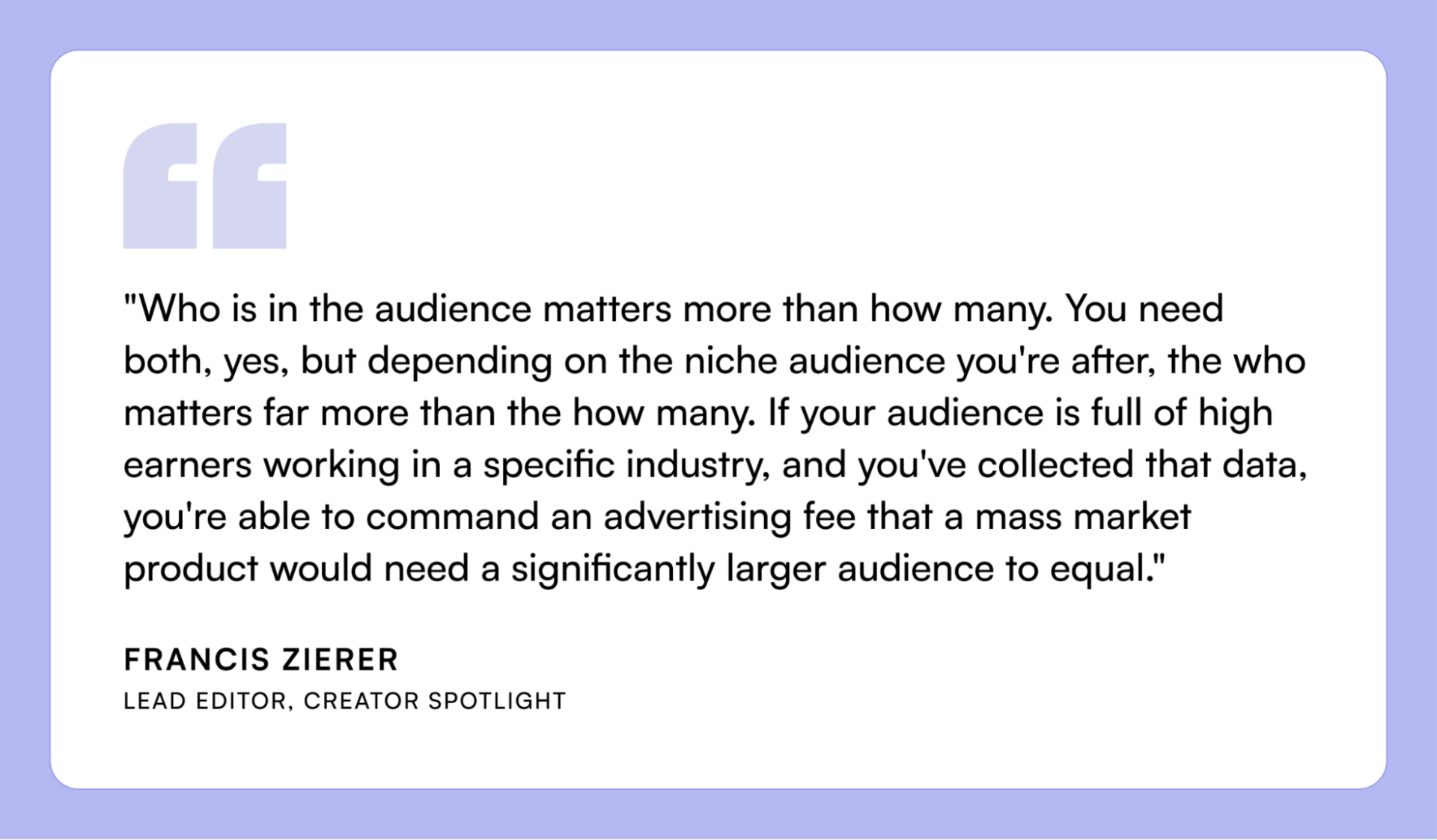
Your move: Stop asking "how can I grow my list?" and start asking "how can I deepen relationships with the readers I have?"
Set up reply-to emails, run Q&As, spotlight community members, and create spaces (digital or physical) where your readers can connect.
3. Consistency Compounds (and Most People Quit Too Soon)
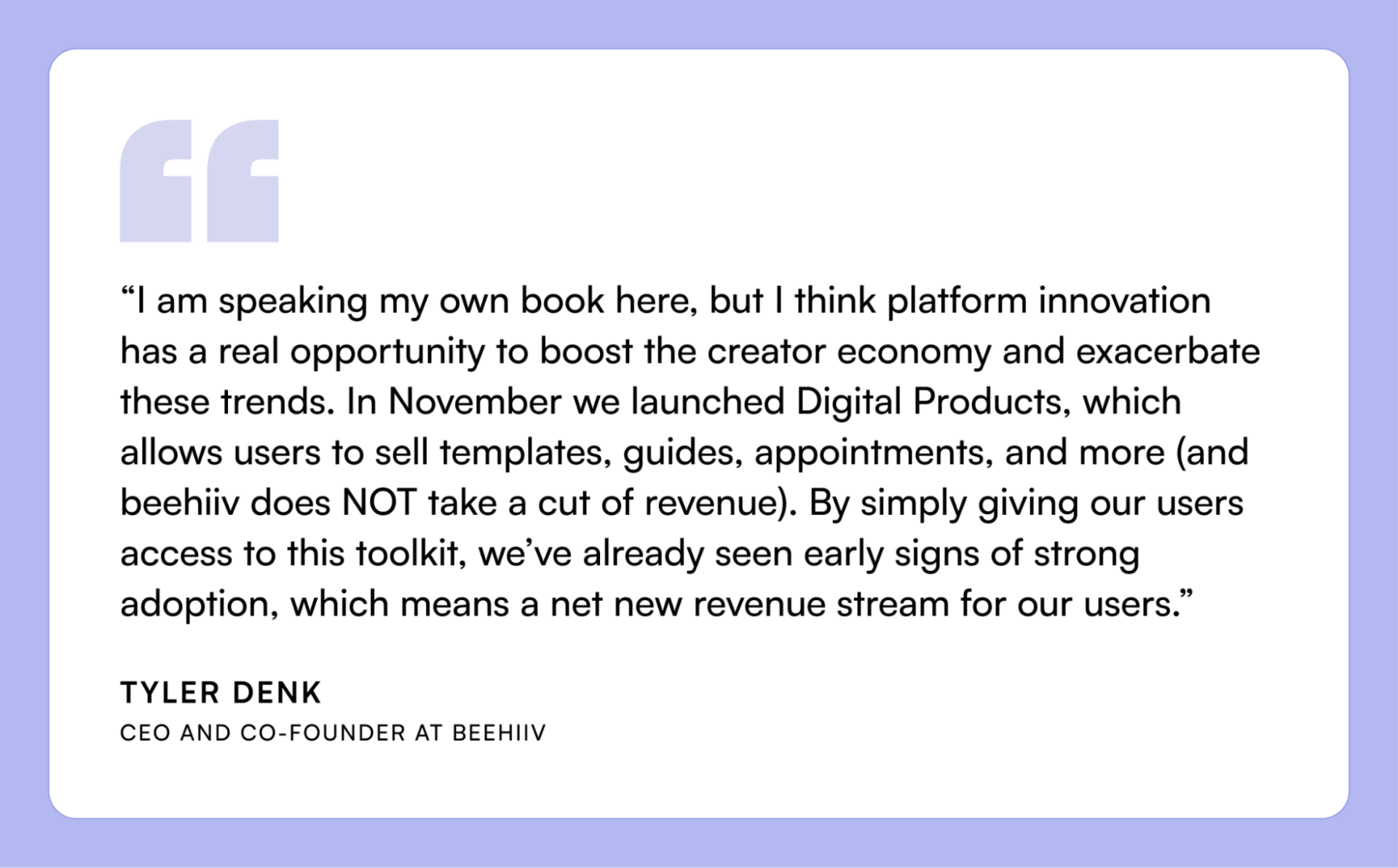
When Tyler Denk was asked about the most underrated levers that separate breakout publications from those that plateau, his answer was simple (but not easy):
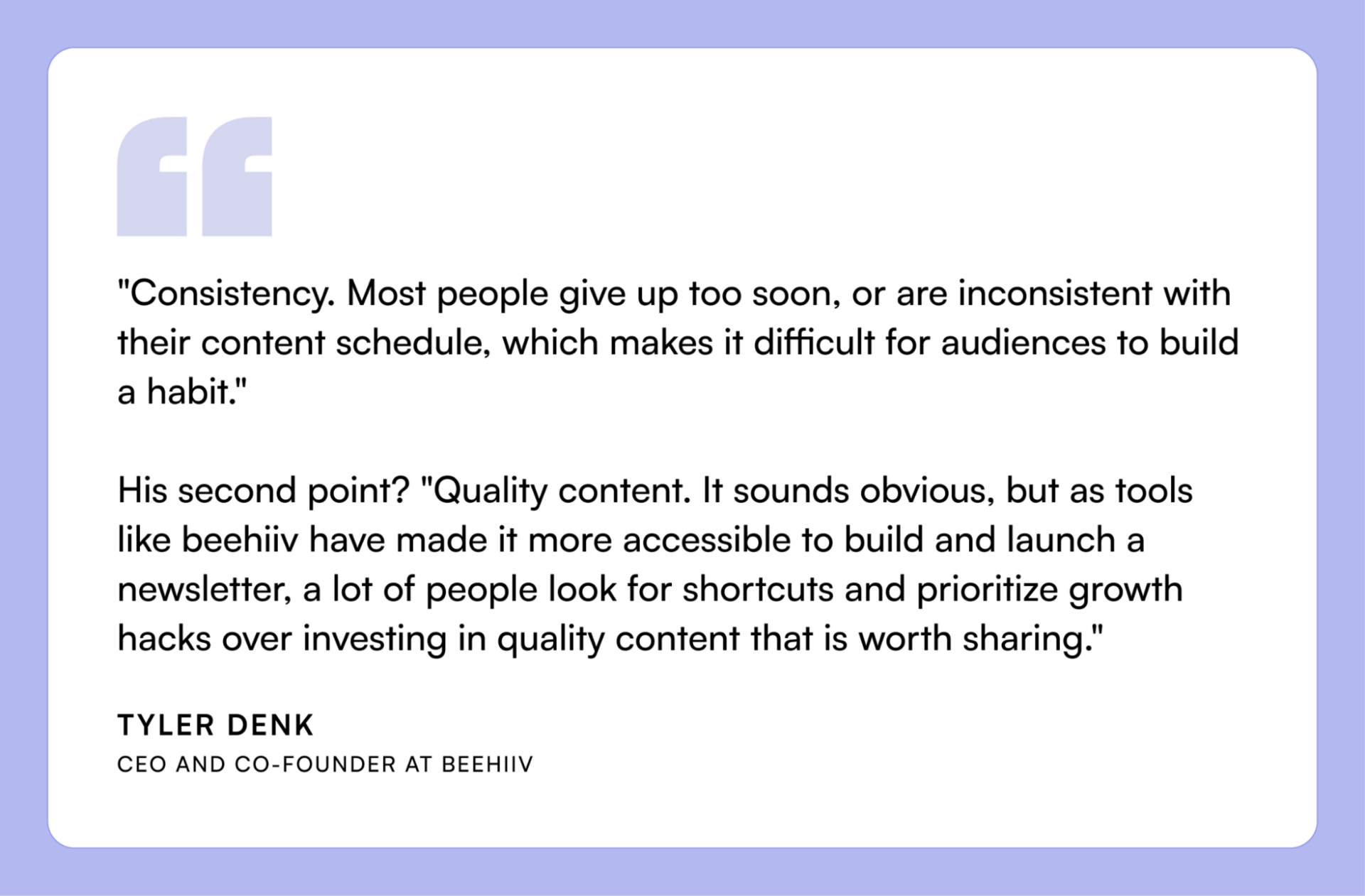
Michael Kauffman of Catskill Crew echoes this with hard-won wisdom: "Patience and persistence. Perfectionism is a breeze that moves you in the right direction - not a headwind. Experience is what you get after you need it."

Ryan Broderick offers the most practical advice for independent operators: "I genuinely do believe that with a few thousand readers on email you kind of have all the social graph you need to grow organically. It might not be as fast as going viral on a big platform, but we had a couple massive hits this year on third party platforms like Reddit and they did not meaningfully move the needle for us. The signups were pretty half-hearted. If you're going independent you don't have a ton of time to waste on anything other than writing. So just focus on that. Focus on the content you're making and how your audience interacts with it."

Your move: Pick a publishing cadence you can sustain, whether that's daily, weekly, or monthly, and protect it religiously. As the data shows, 47.5% of successful newsletters publish weekly. The most important aspect is just showing up when you said you would.
4. Diversify Monetization (But Don't Dilute Your Brand)
The data is clear: sustainable monetization is top of mind for newsletter operators.
When it comes to growth, however, the smartest operators don’t chase every revenue stream. Instead, they’re being intentional about what aligns with their mission.
Girlboss found their sweet spot in a revenue mix that prioritizes audience trust: 58% newsletter ads and partnerships, 30% social partnerships, and 12% from affiliate, podcast, and other streams.
As Kamela Nizio, Content Marketing Manager at Girlboss, explains: "Our relationship with our audience is sacred, so we are always prioritizing our community. Every decision we make at Girlboss starts with listening: what our readers are telling us, what the data shows us, and how the world of work for women is evolving.”

Kyle Denhoff from HubSpot explains the bigger trend: "I think what we're seeing is less of a complete shift and more of an evolution toward diversified revenue streams... Creators are taking a page from that playbook and expanding their options with products, courses, and premium experiences. That said, I think creators and publishers need to be careful not to spread themselves too thin. The strongest operators tend to have one or two really well-executed monetization motions, then expand from there once those foundations are solid."
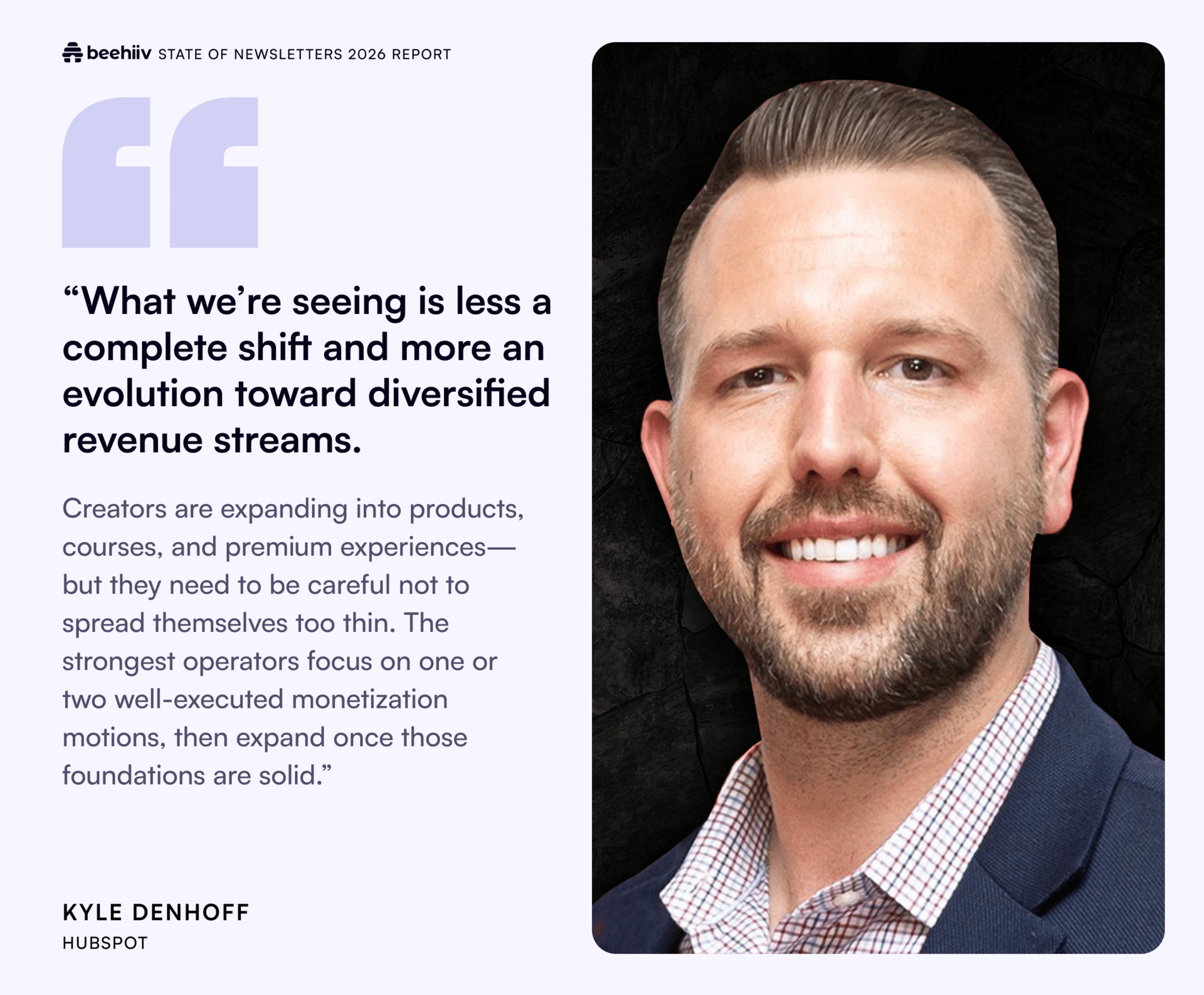
Your move: Start with one revenue stream and nail it before adding more. Paid subscriptions work best for specialized expertise. Ads can work for scale and broad audiences. Products and courses work when you've built deep trust. Pick what fits your content and audience, not what everyone else is doing.
5. Bet on the Physical World in a Digital Era

The most successful digital newsletters are investing heavily in physical experiences. It feels counterintuitive until you look a bit deeper.
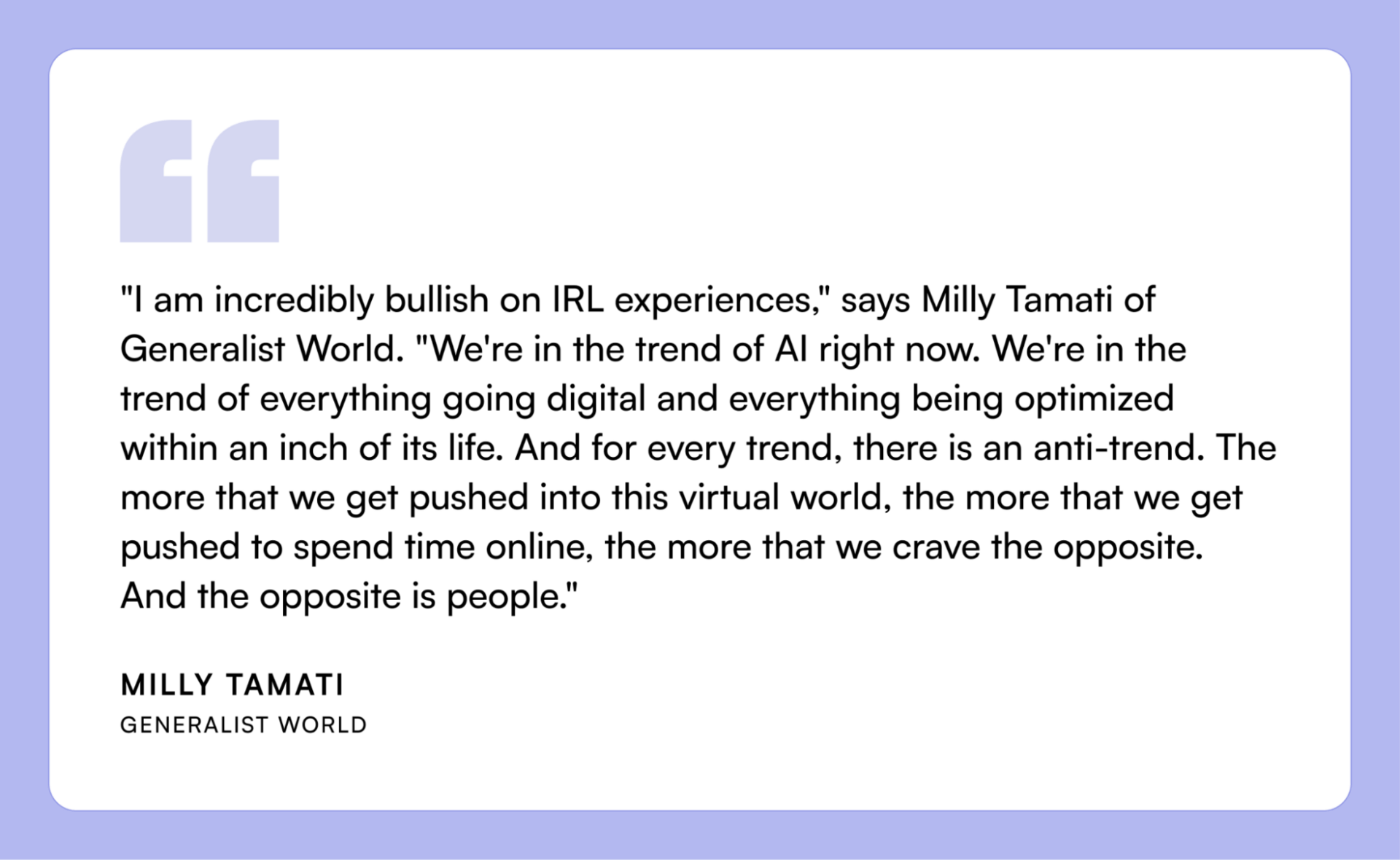

This leads to exceptional retention and reader loyalty that transcends typical newsletter metrics.
Your move: Think beyond the inbox. What could your newsletter become in three dimensions? Meetups, workshops, conferences, or physical products all deepen the relationship and create multiple touchpoints with your audience.
6. Automate the Repetitive, Humanize the Critical
82% of newsletters aren't using ANY automation beyond a basic welcome email. That’s a huge missed opportunity.
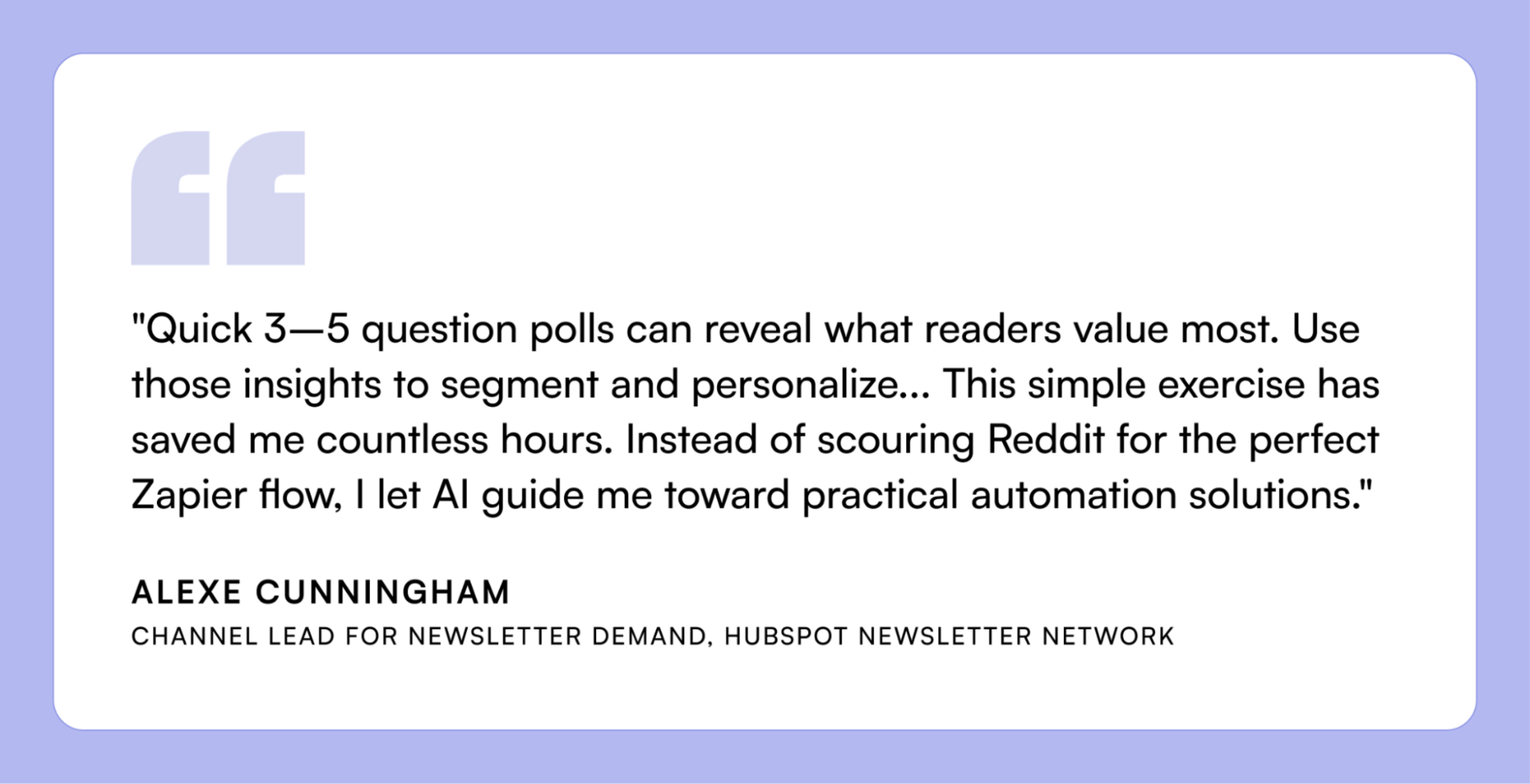
Alexe Cunningham from HubSpot breaks down where AI and automation deliver the most value: "Quick 3–5 question polls can reveal what readers value most. Use those insights to segment and personalize... This simple exercise has saved me countless hours. Instead of scouring Reddit for the perfect Zapier flow, I let AI guide me toward practical automation solutions."
But there's a critical distinction. As Dave Smith notes regarding deliverability and engagement: "Creators will increase their usage of elements like embedded polls, quizzes, and real-time data feeds to allow their audience to interact within the message. This provides a clear, undeniable, and high-value engagement signal that further strengthens sender reputation with ISPs."

Use automation to optimize routine work like send-time optimization, welcome sequences, re-engagement campaigns, and data analysis, while keeping the actual content and community interaction deeply human.
Your move: List every repetitive task in your newsletter workflow. Then ask: "Could automation handle this?" Set up smart systems for onboarding, segmentation, and analysis. Use the time saved to write better, engage deeper, and build stronger relationships.
7. Think Like a Media Company, Not Just a Creator
Dan Krenitsyn offers a provocative reframe: "The oversimplified belief that 'newsletters are the business.' IMO, newsletters are actually just a starting point... a kind of MVP for building an audience, rather than a complete business model. Fun fact: Bridgewater Associates, now the world's largest hedge fund with $90B+ in AUM, was originally started in 1975 as a market research newsletter called 'Daily Observations' published by Ray Dalio from his apartment. Could be any of us."


Your move: Stop thinking of yourself as "just" a newsletter writer. You're building a media property. That means thinking about distribution channels, revenue streams, brand extensions, and audience development with the sophistication of a media executive.

The competition has never been fiercer and the bar for quality has never been higher. The people who win will be the people who care.
Michael Kauffman sums up the mindset that wins: "In a sea of grey, I want color. So I am building what I seek. If I increase my sends, it will only be due to the fact I have more value to share—not because I filled ad slots... The standard is so so so so so low right now. It doesn't take much to shine. There is a difference between service and hospitality. There is a difference between doing something and doing something because you care."

Newsletters give you an uncanny ability to build something that you truly love and care about – and then turn that into a business.
To be successful, you need to invest in quality and community above all else and commit to consistency for building over the long haul.
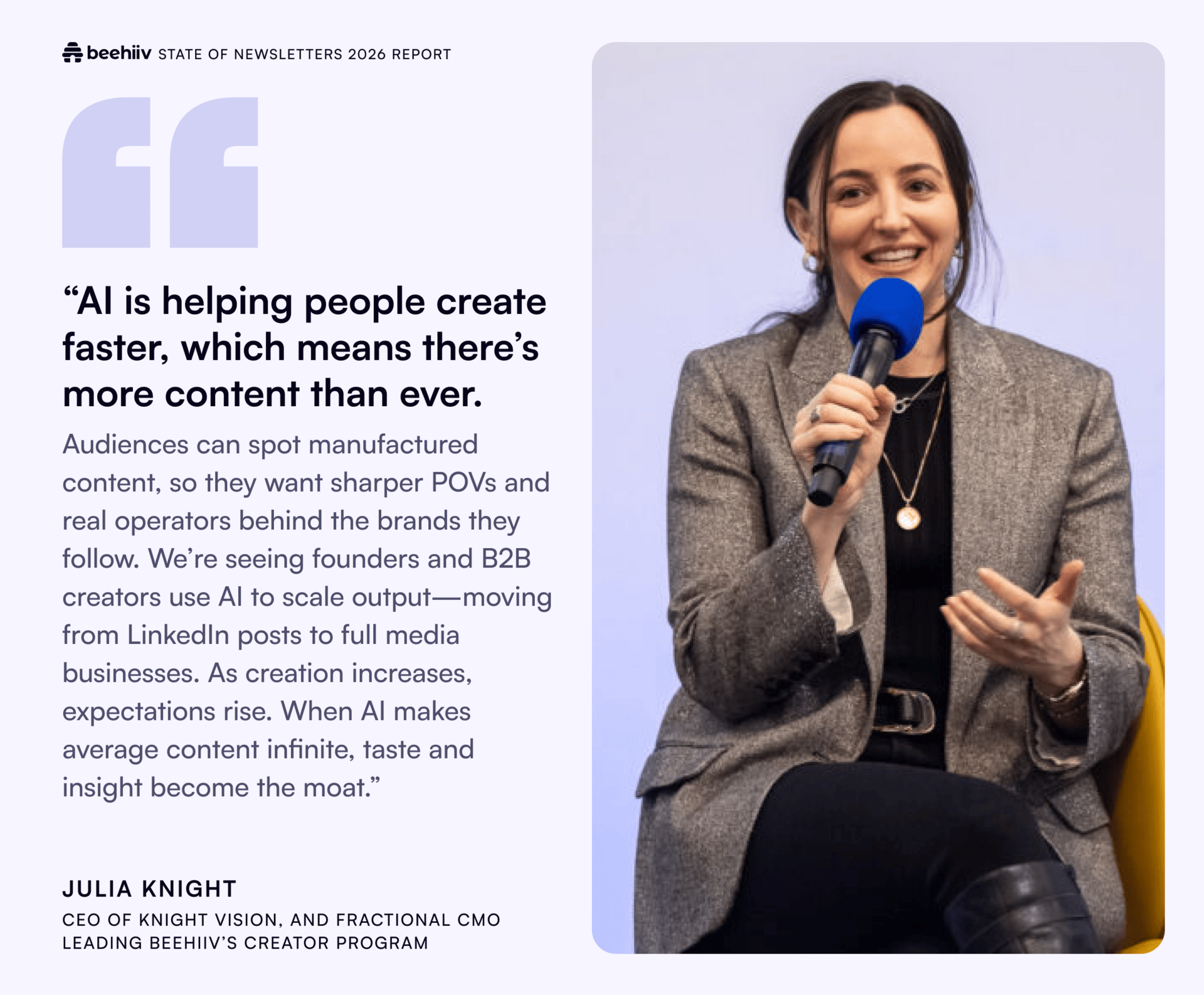
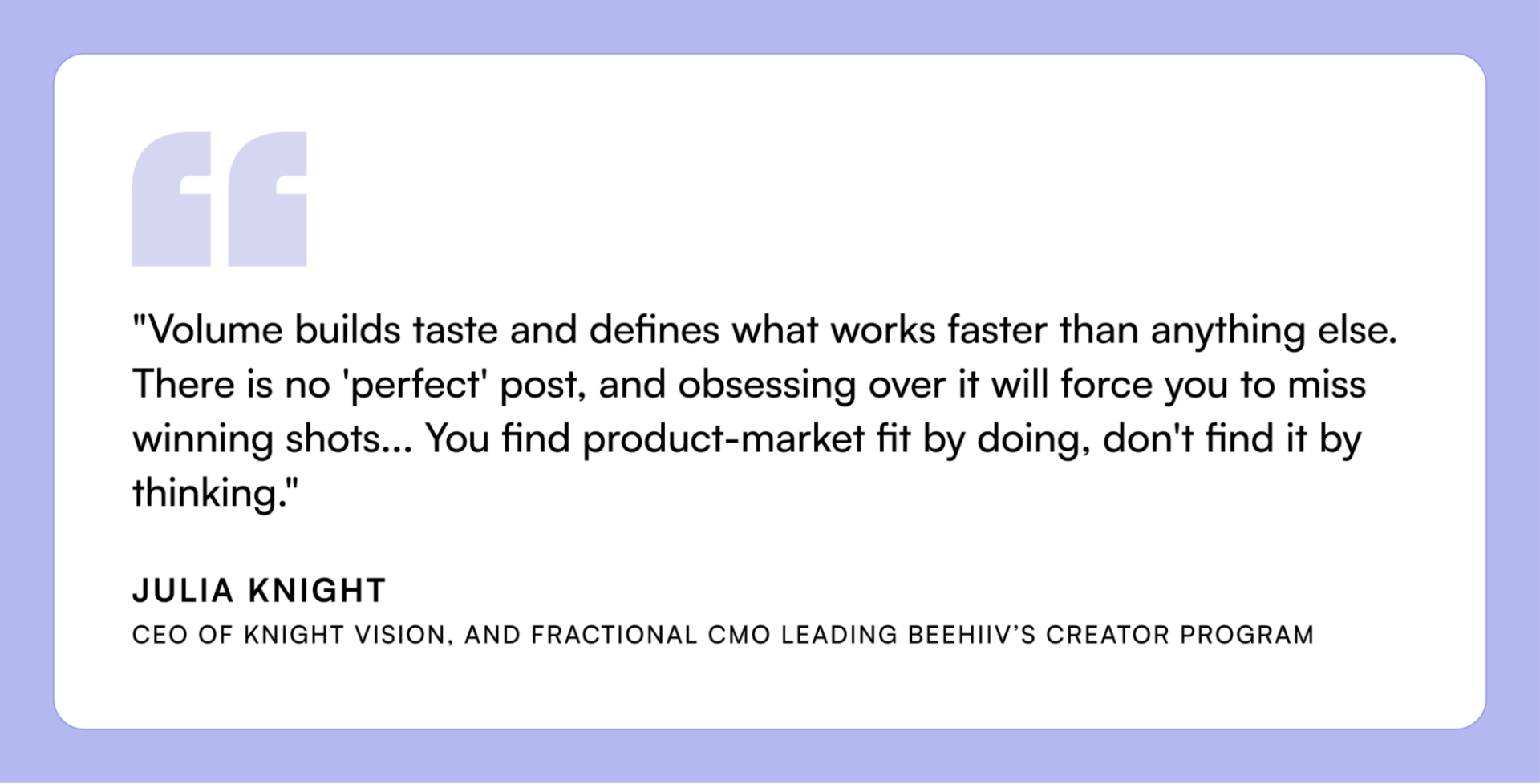
As Julia Knight reminds us: "Volume builds taste and defines what works faster than anything else. There is no 'perfect' post, and obsessing over it will force you to miss winning shots... You find product-market fit by doing, don't find it by thinking."
Start now. Build consistently. Own your audience.
Whether you already have readers or you’re just getting started, newsletters are still the backbone of the content economy. They support every acquisition channel, every distribution loop, and every monetization path.
And while this might sound biased, beehiiv is the place to build — an infrastructure layer that supports the entire content economy across publishing, growth, and monetization.

This report includes data from beehiiv.
Written by Taylor Cromwell and Kanishka Kumawat
Edited by Noelle Daoire
Insights from Alexe Cunningham, Andrei Nedelcu, Austin Rief, Ben Berkley, Dan Krenitsyn, Dave Jorgenson, Dave Smith, Francis Zierer, John Hayes, John O’Keeffe, Julia Knight, Kamela Nizio, Kyle Denhoff, Michael Kauffman, Milly Tamati, Oliver Darcy, Ryan Broderick, Sung-Jae Park, Tony Varghese, Tyler Denk, Victoria Christie
Publications featured include Catskill Crew, Creator Economy NYC, Garbage Day, Generalist World, Girlboss, Half Baked, HubSpot, Just Women’s Sports, LNI Media (Local News International), Morning Brew, Status News, TechCrunch, The Hustle, The Pour Over, TIME, There’s An AI For That
The one place to build.