- Home
- Posts
- 12 Practical Ways To Boost Online Community Engagement
12 Practical Ways To Boost Online Community Engagement
Real-World Strategies To Turn Passive Members Into Active Participants

Nupur Mittal
January 17, 2026

A community without consistent effort is basically a group chat where no one wants to send the first text.
Members join but don’t introduce themselves.
Announcements get no acknowledgement.
Questions go unanswered because no one wants to jump in first.
Lack of community engagement is a sign that members don't have the right prompts, expectations, or drive to contribute.
If you’re seeing the same pattern within your community, this is the guide for you. We’ll share 12 practical online community engagement strategies to invite participation, build trust, and let members make long-lasting connections.
Table of Contents
Why Trust Me? I’ve spent the past four years writing about marketing and growth and working closely with newsletter creators and NGOs. That means I’ve analyzed dozens of newsletters across different niches and paid attention to the patterns that turn casual readers into communities. And, in this guide, I distill my learning to help you start growing an engaged community. |
Why Your Community Engagement Is Low
Low engagement is a direct result of a lack of a clear foundation to create participation. Here are the core reasons you see quiet communities, even when your audience is there:
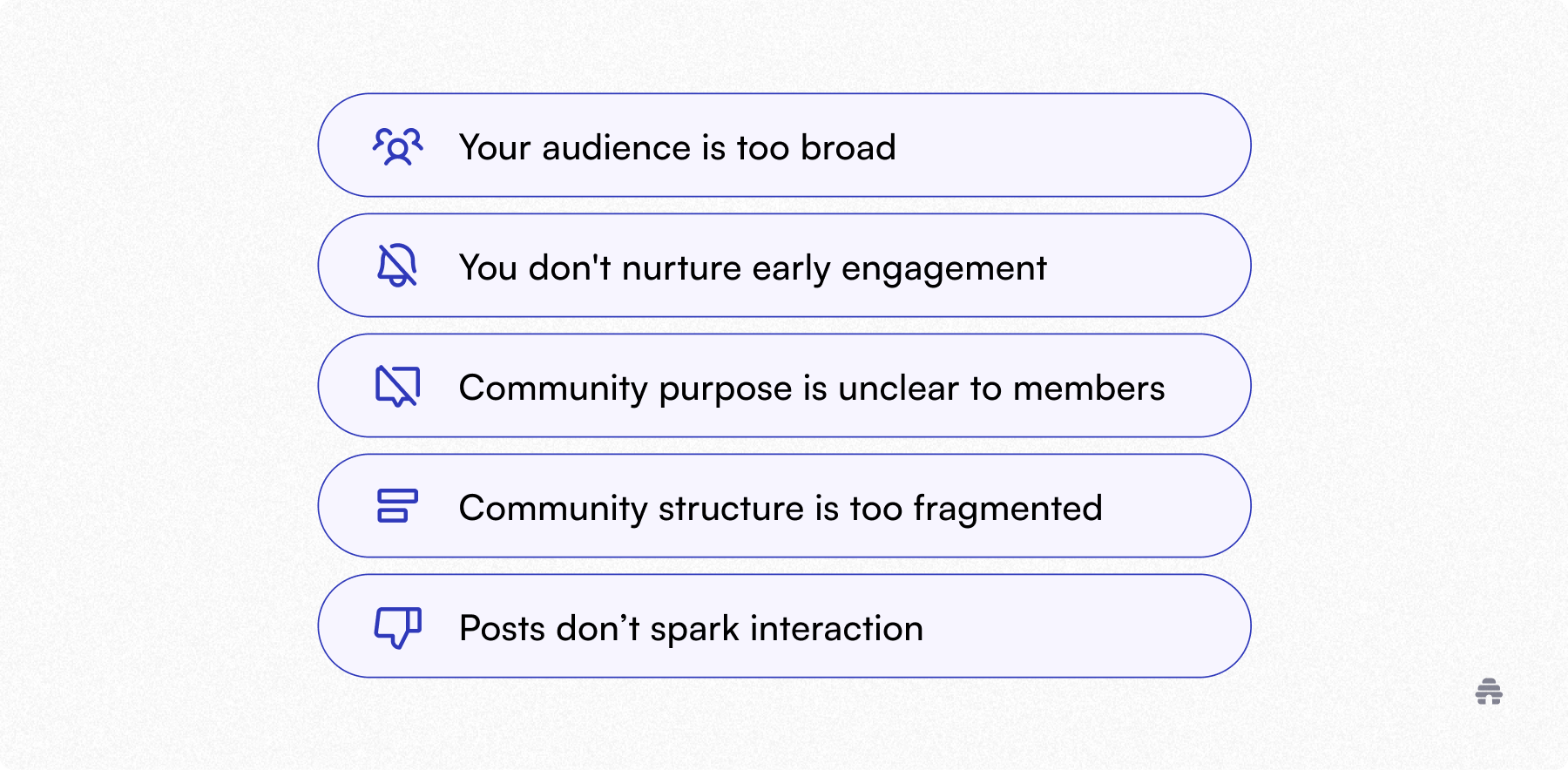
Your Audience Definition Is Too Loose
Engagement slows when members don’t share a clear common ground. If the group mixes people at very different stages or with unrelated goals, they struggle to see where they fit or what conversations to engage in. When the relevance isn’t apparent, participation drops.
You Don’t Have Time To Support Early Interaction
Early communities need your active involvement.
Members take cues from your replies, follow-up questions, and prompts. When your time is stretched thin, those signals disappear. Without early guidance, discussions die quickly, and the space feels inactive, even if people are quietly paying attention.
Members Don’t Understand the Community’s Purpose
Lack of clarity slows participation more than lack of interest. If you let members figure out the community’s purpose on their own—what to post, how to get value, or which conversations belong—they might hesitate.
The Structure Creates Too Much Fragmentation
It’s natural to create channels to keep relevant conversations focused, but too many spaces can dilute activity from members.
When members see overlapping topics across channels or aren’t sure where to post, decision fatigue kicks in. Instead of choosing a channel, they do nothing.
Your Posts Don’t Invite Interaction
Announcements, webinar links, reminders, or content drops keep members informed, but they don’t create conversation. The lack of prompts to invite audience participation or insights makes the community a one-way broadcast.
People join communities to learn from others and share what they know—if posts don’t create openings for that, participation stays low.
12 Online Community Engagement Strategies That Work
Start With a Minimum Viable Community
Before you worry about engagement tactics, check if you have the right people in the room.
Seth Godin has always been a big advocate of building and selecting a minimum viable audience. In one of his blogs, he shares, ’If you could pick the members of this audience, who would you choose? Their dreams, their worldviews, their energy, are all up to you.’
Your primary job is to define that group clearly. Be specific about who you want to gather and why they’d benefit from being together. If your vision is “helping early-stage creators publish consistently,” then that’s who you invite—not everyone who has ever thought about writing.
Starting small also lets you learn what actually resonates. You get real signals: what people ask about, what they ignore, what they get stuck on, and what sparks conversation without you pushing. That’s the data you need before scaling anything.
Treat Onboarding as Activation
Make onboarding as easy as possible to make members get to activation faster.
When a new member or subscriber joins, they’re at peak interest. This is the moment to show them how the community works and give them a reason to stay. Here’s how to do it:
Send a welcome message/email that explains the community’s purpose, vision, and channels. Give them enough context to take the next step.
Share a short task list to encourage immediate participation. Ask them to post an intro, answer a quick poll, or choose a channel.
Introduce them during live sessions if they join while a workshop or town hall is happening. A quick acknowledgment helps them feel included and reduces the distance between “new” and “regular” members.
Encourage them to explore active discussions so they can get caught up and see how people interact.
Check in after a week to collect their thoughts and keep the relationship human. A simple message asking what’s working or what’s unclear goes a long way in building long-term engagement.
Create Rituals So Your Community Has a Pulse
Rituals give your community structure, predictability, and a shared identity. Think of them like recurring moments that reflect what your community values and how members connect with one another.
As Adam Cochrane shares, rituals work when they’re easy to understand, have a clear purpose, and genuinely make sense for the group.
Keep rituals simple. A few strong rituals tied to real needs are enough to create rhythm and belonging:
Teardown Tuesdays: Review a member’s landing page, newsletter, or dashboard.
Bi-weekly walkthroughs: Show members how to do something step-by-step.
Monthly challenge tackling: One member brings a challenge; the group works through it together.
Remember, the quality of rituals matters far more than quantity. If a ritual is easy to understand, repeatable, and gives members a clear return on participation, it becomes something people look forward to rather than another meeting on the calendar.
Naming your rituals helps, too. A unique, in-world name gives the activity a cultural anchor. Over time, those names become shorthand for “this is what we do here,” a clear sign that the ritual belongs to the community.
Host Regular AMA sessions
Ask me anything sessions are a low-lift way to make your audience feel closer to you. They show you’re willing to talk openly, answer their burning questions without gatekeeping, and share what’s happening behind the scenes.
Our CEO, Tyler Denk, announced on LinkedIn about hosting an AMA session on Reddit, and our audience didn’t disappoint.

He ended up answering more than 100 comments from readers, founders, and newsletter operators. It worked because on Reddit, people don’t want to be sold to. It was not promotional as we’re genuinely interested in listening to our users’ questions and answering them.
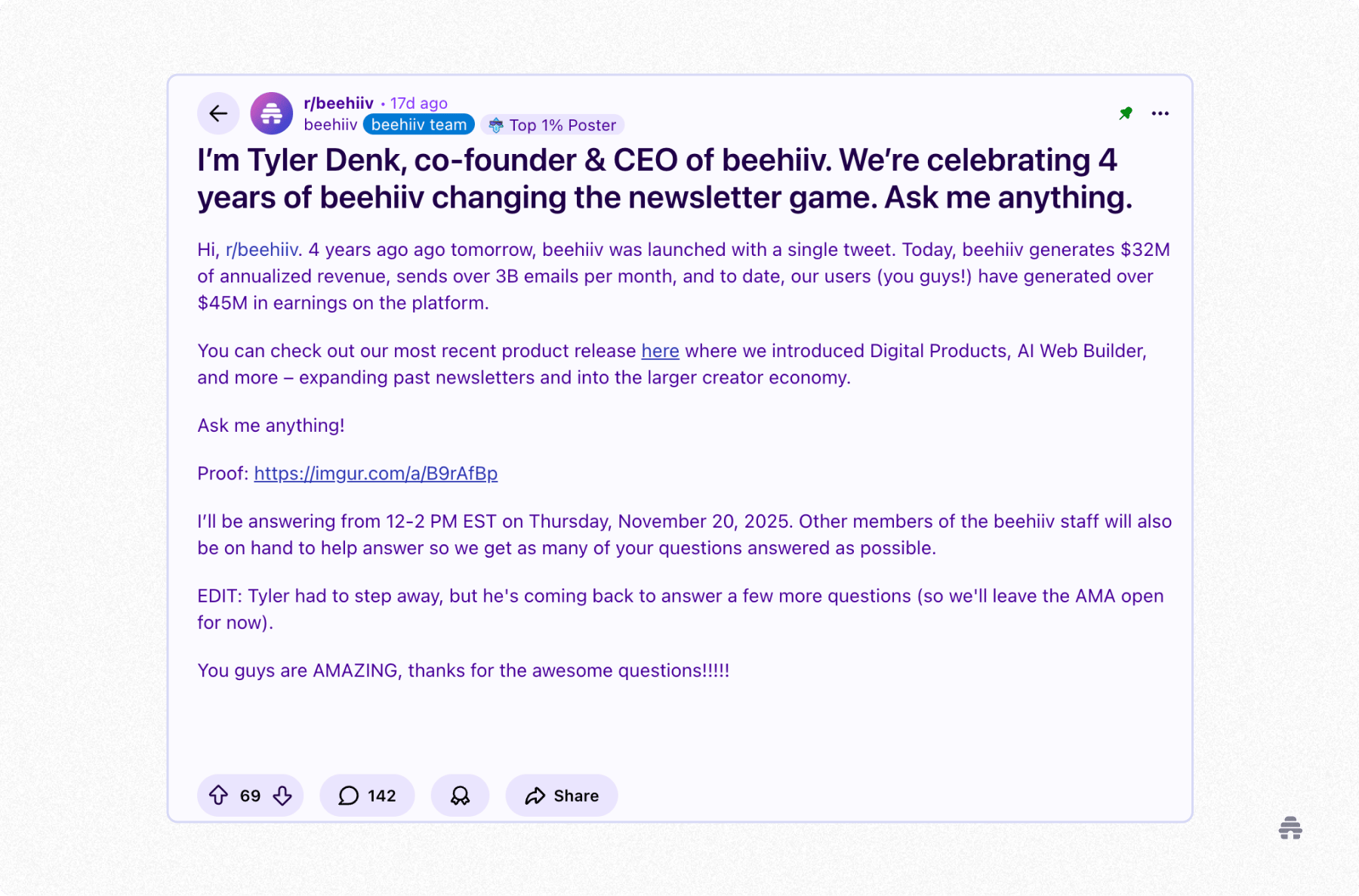
Another benefit of hosting such AMA sessions (and it is data-backed) is that they help reduce First-Response Time. You answer questions in real-time, which leads to more conversations and eventually boosts engagement.
AMAs don’t need to be fancy. Pick a platform your audience is most likely to engage with, tell people when you’ll be there, and answer questions openly. It’s one of the fastest ways to boost participation and spread the word about your community.
Design Member-To-Member Connections on Purpose
The strongest communities aren’t built around the creator, but around the relationships between members.
The more meaningful relationships someone builds inside your community, the harder it is for them to drift away. They’re not just leaving a Slack workspace or a Discord server; they’re stepping away from people who know them.
Strengthen these ties with these low-friction tactics:
Monthly Pods: Keep these groups small (3-5 people) grouped by stage or interest, like those with 0-1K subscribers or creators experimenting with paid tiers. Give them a short agenda and a frequency so the group knows what success looks like.
One-to-one Intros: Once a week, pick two members who should know each other and connect them with a short note explaining why. The note matters as it makes the intro feel intentional.
Shared “Help & Offers”: Members list what they’re good at and what they need help with. This lowers the barrier to collaboration and makes it obvious where someone can contribute or who they might want to reach out to.
Indie Hackers grew in large part because of this kind of design. Members weren’t just there to hear from the founder. They were there to build in public and support each other.
Turn Active Members Into Hosts
Make your most active and engaged members feel they have a stake in the group.
Start by spotting a core group of champions—people who answer questions thoughtfully, ship interesting projects, or naturally support others. Spot them early on and invite them into a more active role.
For example, one group might moderate a recurring session. Another can keep a specific channel organized and active. A “welcome squad” can greet new members and help them settle in. These small ownership moments compound into a much healthier, more self-sustaining community.
Developer and dev tool communities have done this for decades by turning productive members into “champions” and giving them meetups or channels to run.
Collaborate and Co-Create
Nothing deepens community engagement faster than making something together. Collaborative projects give members a sense of ownership, belonging, and shared purpose.
Keep it simple: ask people to contribute recommended books for a reading list, must-listen podcasts, or create a calendar of industry events. Such tasks give everyone a low-pressure way to participate while producing something genuinely useful for everyone.
You can also host virtual sessions built around what your members want to learn.
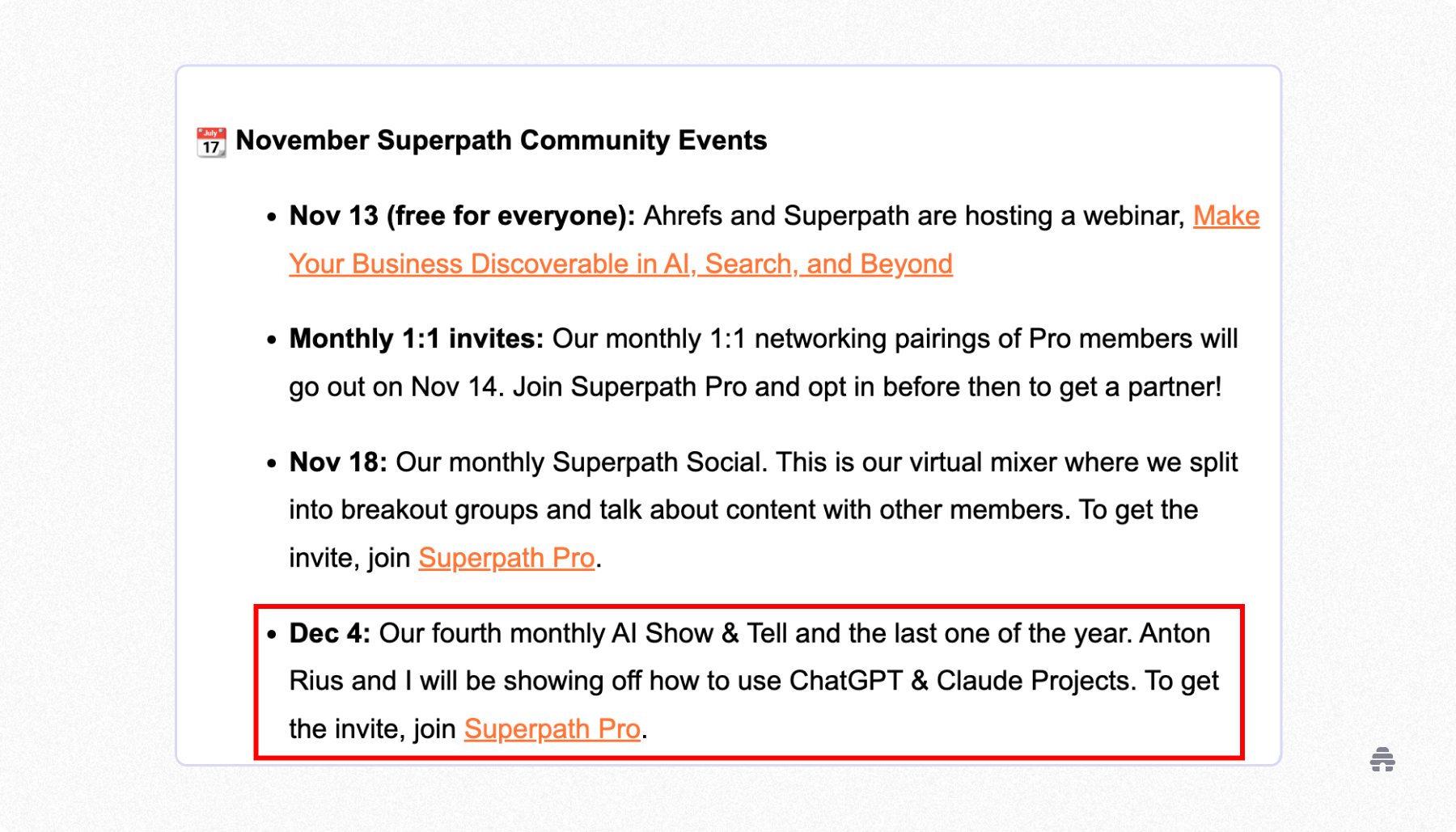
Superpath, a community for content marketers, does this so well. Their monthly “AI Show & Tell” invites members to share their workflows and tools with the rest of the community. Such input from members is what creates ownership and turns members into genuine contributors.
Ask for Members’ Feedback
If you listen closely, your community will tell you what to write about, what to improve, and where they’re getting stuck.
But good feedback doesn’t appear on its own. Ask for it intentionally and know how to interpret the signals.
Start with the basics. Send a feedback email form to gather thoughts on your content, the community experience, and anything members want more (or less) of. It won’t capture everything, but it will give a baseline.
From there, pay attention to patterns. This is where the real signal emerges:
If the same theme shows up across multiple threads, make a note of it.
If several potential subscribers drop off at the same step, that tells something.
If a particular newsletter topic consistently drives engagement, that’s your content theme.
Periodically review the feedback and show your audience what changed because of their feedback. This builds trust and makes people more willing to give thoughtful input in the future.
Create Low-Stakes Spaces To Pull People In
Not every conversation in the community needs to be about work, growth, or tasks at hand. In fact, some of the most effective engagement drivers are conversations that are unrelated and feel lightweight (and fun).
For example, at beehiiv, we made a Puzzles channel in our hiiv community. It led to higher engagement, as members checked in on the puzzle or submitted their daily scores. This small, repeatable action gives them a reason to open the community regularly and contribute in other channels.
The best thing about the puzzle channel was that it lowered the bar for participation. Members don’t need to be experts at solving a puzzle. It’s an easy win that builds the habit of showing up.
Creating such non-work-related spaces works as “entry points” to get people through the door. The more often members show up, the more comfortable they become participating in other channels.
A few ideas that work well for creator communities:
Daily puzzles or brain teasers
Casual check-in threads
Light prompts like “What are you reading?” or “What shipped today?”
Low-pressure challenges with no right answer
Add a Comments Section to Your Blog/Newsletter
A comment section is one of the simplest ways to spark participation around your content.
A comment section gives readers a space to share their thoughts and dive into others’ opinions. This can create a long line of threads with flowing conversation. You also learn what people care about, what’s unclear, and what topics are worth expanding. Over time, those comments become a reliable source of ideas and credibility.
On beehiiv, this becomes even more powerful because comments sit directly on every published post. You don’t need plugins, custom setups, or another tool to manage. Readers engage in the same place they read, which keeps the conversation consistent and friction low.
The tradeoff is maintenance. A healthy comment section requires attention: responding to thoughtful feedback, clearing out spam, and keeping discussions on track. But if you treat it as an active part of your community rather than an afterthought, it quickly becomes one of the most useful signals you have.
Encourage Anonymous Questions/Stories Submissions
Not everyone is comfortable asking questions publicly.
Some people are shy, some don’t want to look uninformed, and some simply prefer privacy when discussing sensitive topics. Offering an anonymous way to ask questions gives those members a voice and brings more perspectives into the conversation.
You can do this through a simple Google Form or any equivalent tool. Keep it always on and easy to find so members can submit questions whenever something comes up.
Lizzie Davey, a freelance content strategist and writer of Freelance Money Diaries, invites freelancers to share their stories with the option to remain anonymous.

It’s a low-effort tactic that encourages participation from people who might otherwise stay silent, builds trust, and surfaces themes worth exploring in future content.
Be Clear in Your Community Guidelines
If you’ve ever had a post removed from Reddit, you already understand why community guidelines matter. Clear expectations prevent needless friction and help you maintain a space where people feel comfortable contributing.
Be explicit about what the community is for and how you expect people to behave. This doesn’t need to be a 50-page policy. A short automated message or a simple welcome email is enough (as long as it communicates the essentials):
Purpose of the community
Types of posts that are welcome
Guidelines for asking for help and getting useful responses
Boundaries around spam, self-promotion, and harmful behavior
How moderation is handled and what to expect when issues arise
Here’s a really good example of community guidelines from the community-led alliance Slack community.
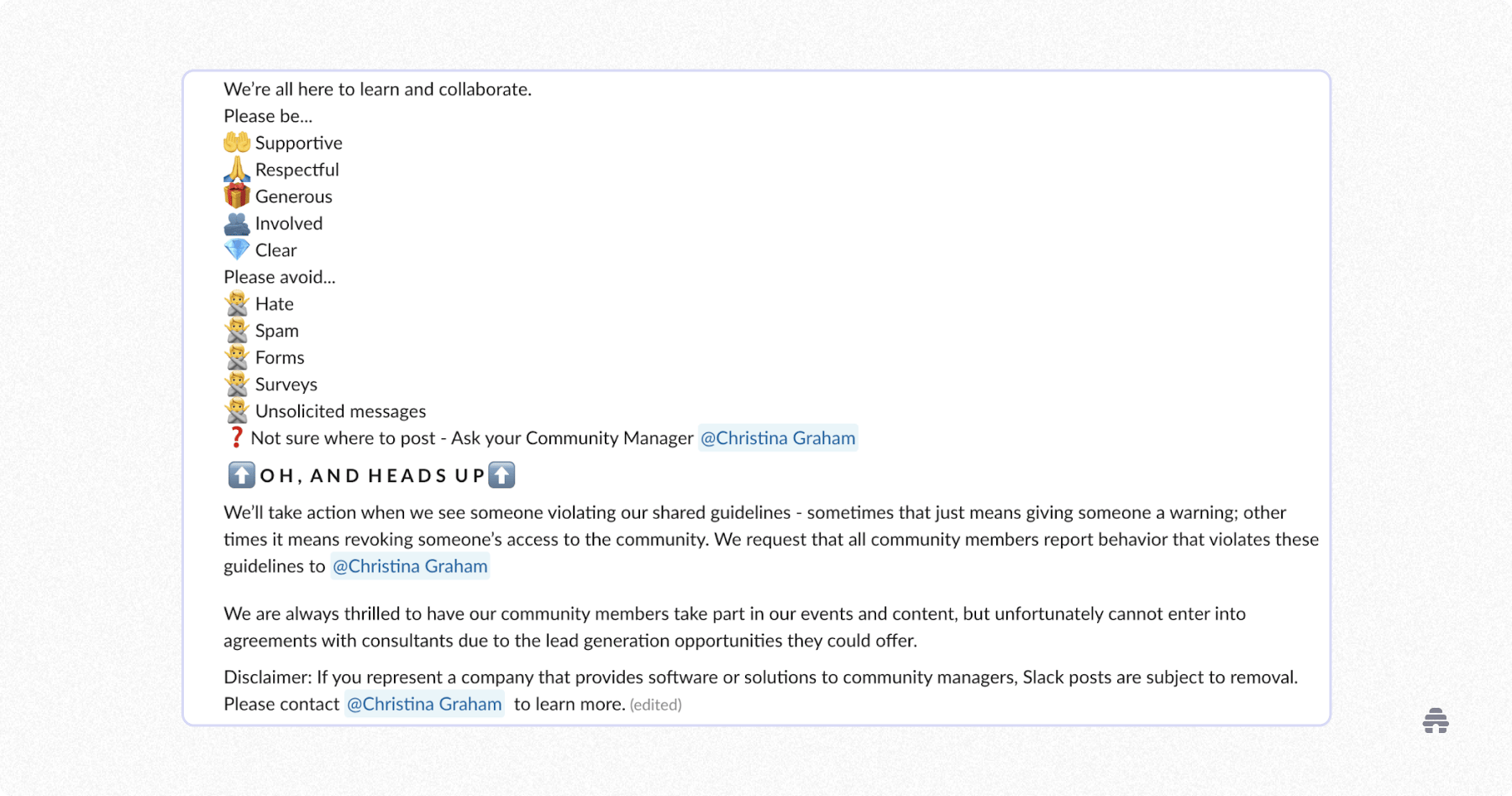
Language also shapes a community's culture. The names you give channels and rituals, the prompts you write, and the phrases you repeat all signal how people should interact. Over time, these choices become part of the community’s identity.
Stack Overflow, for example, runs on very strict norms. You don’t need that level of formality, but you do need clarity. Clarity lets people relax and participate without worrying they’re “doing it wrong.
Create Community Moments Worth Remembering
Create shared moments to give members something to bond over—an experience tied to people who share their interests, energy, or goals
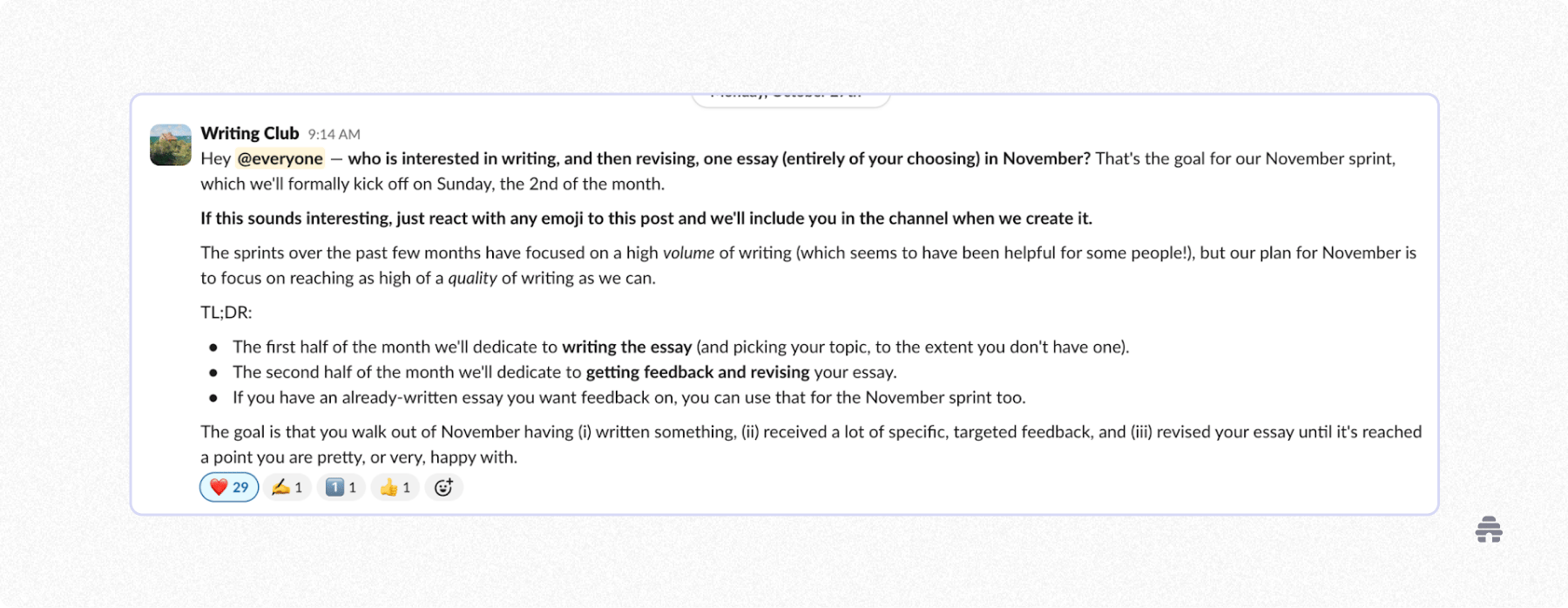
Writing Club, a Slack community, does this well through monthly writing sprints. Each month has a theme, and members share progress, exchange feedback, and talk through their process.
It’s a simple format that includes people with different preferences while helping them meet others who care about the same things.
Here are a few ideas you can try:
A 30-day LinkedIn posting challenge
Monthly “vibe-coding” or co-working sessions
“30 Days of Shipping Something Small”
A shared goal like hitting a subscriber milestone together
Don’t forget to celebrate these milestones by giving members a shoutout or highlighting their wins in your newsletter.
Documenting these moments can also help give new members a taste of what it's like to be part of the community. Keep a “Hall of Fame” post or page that collects key moments with screenshots, links, and short descriptions.
Boost Engagement Through Interactive Elements in Email
Use email newsletter as a touchpoint to boost community participation. Add interactive elements like polls, surveys, quick challenges, or reply prompts to give readers something to do, not just something to read.
Think of interactive elements as micro-engagement loops:
A single-click poll turns a passive reader into an active participant, even if they only have five seconds.
A short survey is a quick way to gather feedback about the newsletter content or any other question you may want to ask.
A “hit reply and tell me…” question prompts readers to share their thoughts, and it also boosts your sender’s reputation.
These lightweight interactions train your audience to participate regularly and let you in on what’s resonating with them.
How beehiiv Makes Community Engagement Ridiculously Easy
Centralize Your Community and Content
beehiiv keeps your newsletter, website, and membership system under one login so everything works together and your audience always knows where to go.
Because your content and site are managed inside one platform, you don’t waste time switching tools or rebuilding posts. You can publish quickly, stay consistent, and keep everything organized without version-control headaches.
Each post is saved and published to your website, creating a built-in archive without any extra setup. Your community always has access to past content, and you can easily resurface posts when someone asks a related question or when you see older topics gaining traction again.
Run free and paid communities directly through your site and manage everything inside beehiiv. You can track revenue, manage subscription tiers, and monitor members’ activity without jumping across payment tools or spreadsheets to see who joined or where they came from.
Segment Your Audience and Create Dynamic Content
beehiiv helps you keep sending relevant content through smart segmentation. As you collect audience interaction data within the platform, you can use multiple conditions and attributes to create segments.
Once you understand your audience segments, you can send newsletters that adapt to each group. This is where dynamic content earns its keep. You show different blocks of content to different readers based on what they’ve shown interest in or how they’ve interacted in the past.
Jennifer Chou, creator of Vegan Tech Nomad, used dynamic content to promote her Notion templates and premium content. She automatically excluded readers who had already purchased, and this helped her add more than 10,000 new subscribers in two weeks.

Track Audience Engagement Metrics Across Email and Website
beehiiv really shines with its integrated newsletter and website analytics. From reader’s email interaction to web traffic sources, you see an accurate picture of your audience’s behavior without switching across tools.
The analytics dashboard goes beyond baseline information and provides a detailed analysis of your email performance. There are three interconnected reports:
Subscriber Reports: Track where subscribers come from, how they engage over time, and how different cohorts retain. Helps you see which channels attract members who actually participate.
Post Reports: Break down each newsletter and web post with detailed opens, clicks, unsubscribes, and long-tail engagement. Helps you identify the topics and formats that consistently spark interest or discussion.
Click Reports: Show which links earn the most attention, revealing what your audience values and where they want to go deeper. Helps you make smarter decisions on future content, sessions, and series.

Noah Edelman, the co-founder of The Neuron, loves beehiiv’s 3D analytics features. Edelman says, ‘It’s crucial to have engaged subscribers if you want to run your business the right way, and 3D analytics allowed him to keep a close watch on his readers.’

Website Analytics
Your community engagement rarely lives in one place, and that’s precisely what beehiiv’s new website analytics helps you with. It extends visibility beyond the inbox and shows traffic sources, reading patterns, and on-site behavior in real time.
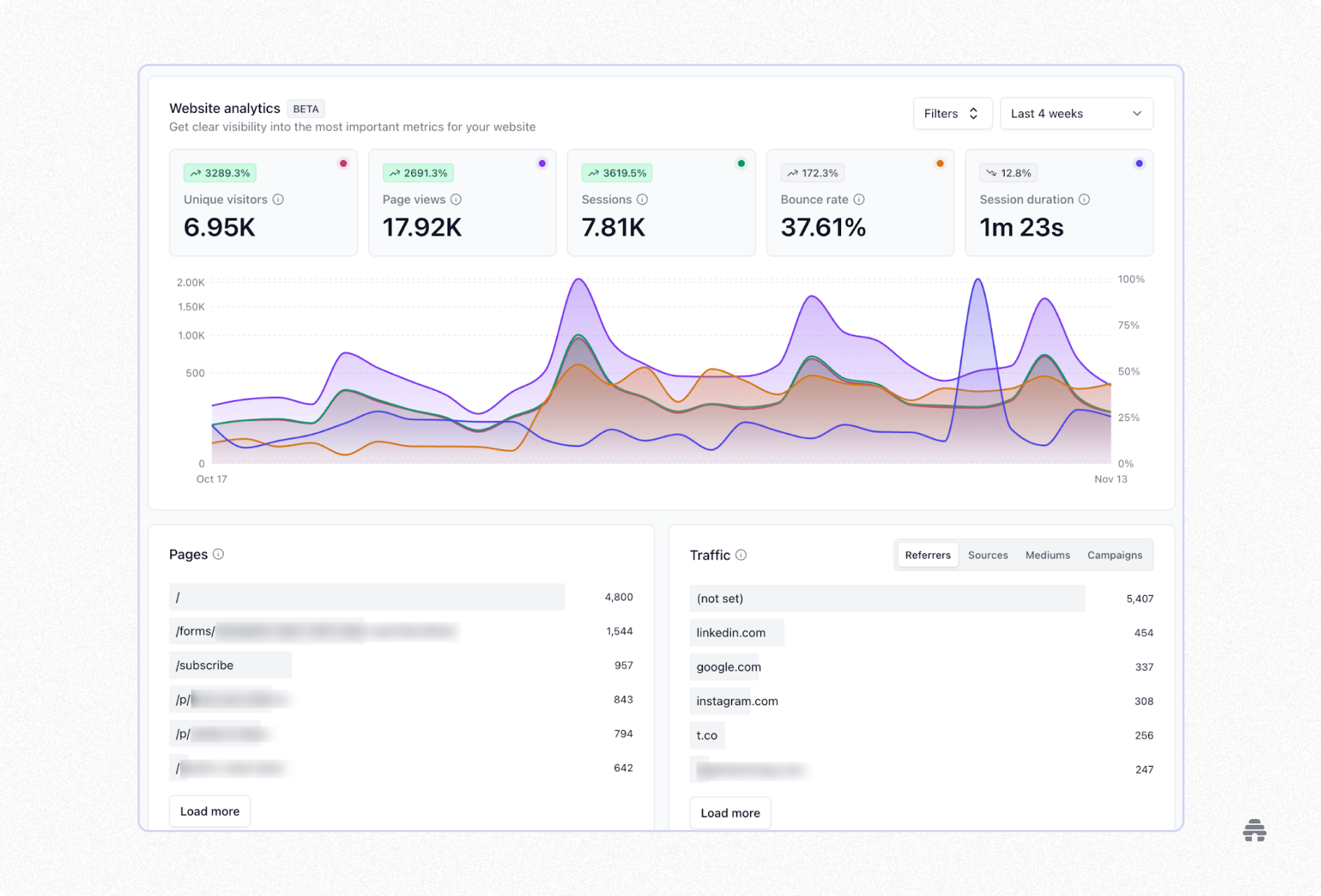
When your audience’s behavior across the newsletter and website is gathered under one system, you can finally see how they engage end-to-end:
Subscriber opens a newsletter → clicks on the site → reads two more posts → subscribes to a paid tier → replies to the next issue. Or, they open inconsistently → never click → bounce quickly from the site → slowly disengage.
This visibility helps you:
Identify the posts that spark ongoing discussion or get referenced in community threads
Understand which platforms bring in readers who actually participate
Turn high-performing web articles into workshops, challenges, or deeper community conversations
Wrapping It All Together
Community engagement builds slowly. Some days will be quiet, especially early on, but if you stay intentional and aligned with your purpose, participation becomes steadier and easier to sustain.
And to keep the process simple, beehiiv helps by putting your newsletter, website, and analytics in one place.
You spend less time managing tools and more time noticing what your audience actually does. That’s what moves engagement forward. Try beehiiv for free today!

FAQs
How Do Online Communities Work?
Online communities work by giving people a shared goal, interest, or challenge, and a place to connect and support each other. As a creator, you set the purpose and the structure of the community, but the value comes from members interacting with each other—asking questions, sharing progress, giving feedback, and swapping ideas.
How Do You Start Your Own Community?
Clarify the purpose, define who the community is for, and choose one platform to host it on. Create a simple, easy-to-follow onboarding flow to keep members engaged. Spend time engaging with members by answering their questions, conducting virtual sessions, or hosting monthly town halls.
How Do You Create an Engaged Online Community?
Community engagement grows when you’re consistent. You send regular prompts, build recurring rituals, and welcome members. The more predictable and relevant the interactions feel, the more likely people are to participate.
What Are the Best Online Community Platforms?
The “best” platform depends on your audience and the community's purpose. Here are some of the common community platforms you can explore:
Slack: Widely known, ready-to-use, and offers tons of community-specific tools.
Discord: Great for active, hobbyist, or technical communities.
Circle: Clean structure, courses + community in one place.
Skool: Simple UX, easy onboarding, community + education features.
beehiiv: Ideal if your community is connected to your newsletter and content, and you need to dive deeper into engagement metrics.
Do Online Communities Make Money?
Online communities can make money. Usually, revenue comes from paid memberships, premium content, workshops, courses, coaching, or partnerships. But you can earn through communities if you deliver helpful content for members and keep the engagement high.
Related Articles



The one place to build.
Get beehiiv updates delivered directly to your inbox.
By subscribing you agree to our Privacy Policy and provide consent to receive updates from our company.