- Home
- Posts
- Escaping the Subscription Plateau: Diversify Your Revenue
Escaping the Subscription Plateau: Diversify Your Revenue
Global Subscriptions Plateaued in 2025; Diversified Creators Now Earn 3x More

Kanishka
December 27, 2025

Beyond Subscriptions: How Diversified Revenue Became the Creator Growth Engine

The global subscription economy hit $722 billion in 2025 and is still projected to reach $1.2 trillion by 2030. On paper, that sounds like endless upside.
But if you zoom in on the numbers, the story shifts.
Digital subscriptions grew from 917 million in late 2024 to 923 million in early 2025 — an increase of just 0.65%. The market is saturated. Consumers are maxed out. Growth is slowing.
For creators, that slowdown exposes the hard limits of paid-only models:
Subscription fatigue is driving churn up by roughly 23%
Customer acquisition costs (CAC) are up about 67% since 2021
Platforms taking 10%+ fees on subscription revenue quietly skim off your upside
Meanwhile, the broader creator economy, valued at around $191.55 billion in 2025 and projected to hit $528 billion by 2030, is evolving fast. Creators who rely solely on paid subs are leaving serious money on the table.
Those who diversify — layering in ads, boosts (paid recommendations), sponsorships, and digital products — are earning roughly 3x more than creators tied to a single revenue stream.
This isn’t an argument against paid subscriptions.
It’s an argument against paid-only.
Subscriptions Are Powerful — But They’re No Longer Enough
Paid newsletters changed the game. They gave creators something they never had before: predictable, recurring income tied directly to their audience.
That doesn’t go away.
But in 2025, subscriptions are the floor, not the ceiling.
A few structural realities:
The pool of people willing to add yet another subscription is shrinking
The cost to acquire each subscriber keeps rising
Platforms that take a 10% cut on subscription revenue quietly cap your long-term potential
If you’re doing $100,000/year in subscription revenue on a 10% fee platform, that’s:
$10,000/year gone
Every year
For the privilege of using a checkout and email tool
Stretch that out over a few years of growth, and you’re burning the equivalent of a full-time hire or a serious growth budget — purely in platform tax.
Paid subs are still essential. But in a saturated market, you need more than one lever.
That’s where diversification comes in.
Subscription-Only vs. Diversified Revenue in 2025
Think about it this way:
A subscription-only business lives or dies on one metric: net subscriber growth
A diversified business stacks multiple revenue engines on top of the same audience
Here’s how those models compare in 2025:
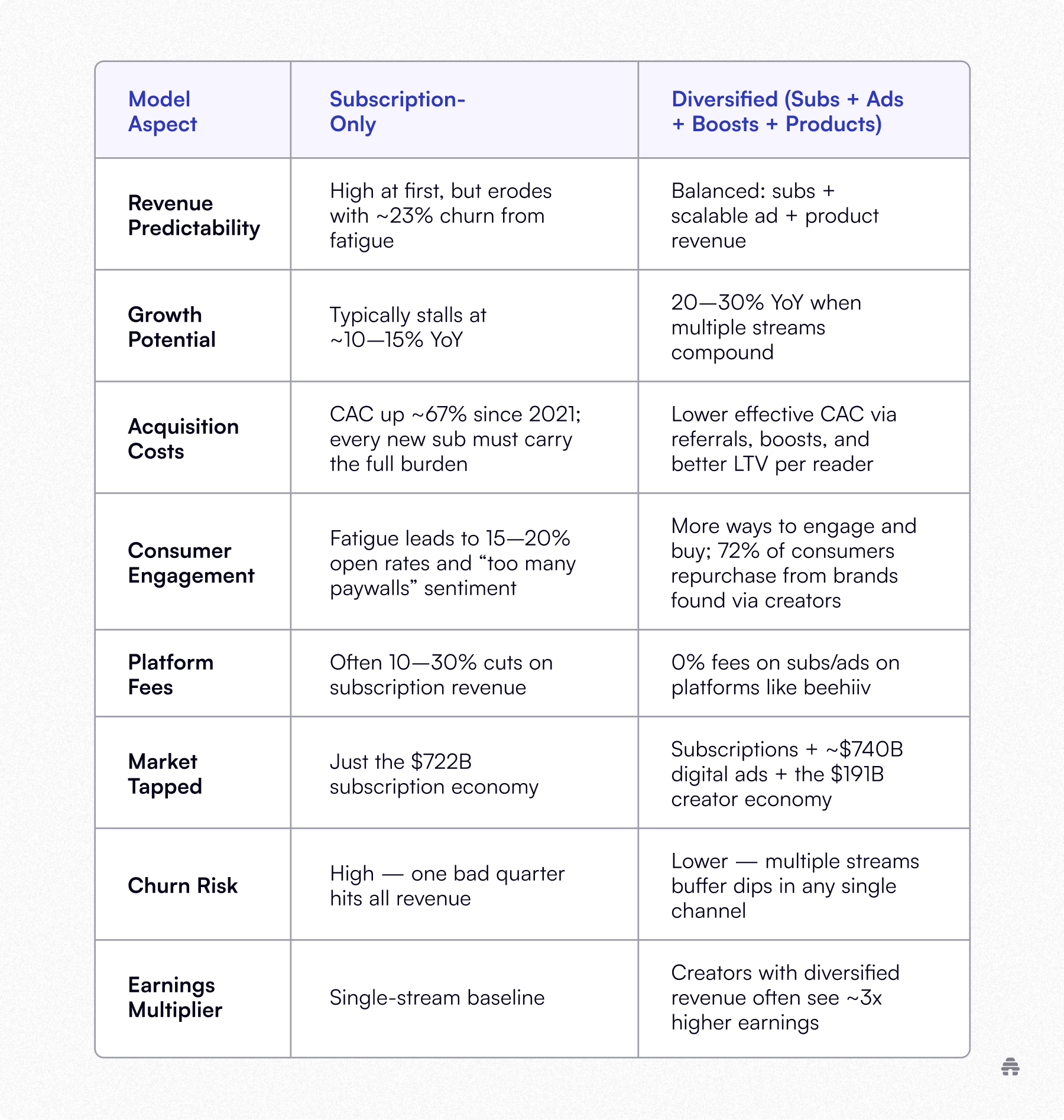
The takeaway is pretty simple:
Subscriptions are a strong engine.
Diversification turns your newsletter into a business, not just a paywall.
Why Paid-Only Models Are Hitting a Wall
Subscriptions exploded after 2020. Every brand, platform, and creator rushed to launch one.
By 2025, the cracks are obvious.

1. Subscription Fatigue Is Real
Consumers are juggling:
Video streaming
News
Fitness
Software
Creator memberships
…all at once. There’s a limit.
When budgets tighten, people don’t cancel everything — they prune. And yes, creator subscriptions are on that list.
That shows up in the data as:
Higher churn (roughly 23% above pre-2021 levels)
Flat or declining net-new subscribers, even as creators publish more
A general sense of “I can’t pay for every Substack / Patreon / membership I like”
If your whole model is: “Pay me every month or you don’t get anything,” you’re now in competition with every other subscription in someone’s life.
That’s a tough place to be.

2. CAC Keeps Rising — And Subs Have To Carry All the Weight
Customer acquisition costs are up about 67% since 2021.
If the only way you earn is via a subscription, every subscriber has to justify that entire CAC. That’s fine at a small scale or in a wildly underpriced niche.
But as you grow, it creates real pressure:
You push harder to keep churn down
You feel guilty raising prices
You overpublish just to “justify” the fee
Burnout creeps in (over 50% of creators report it; ~37% have considered quitting)
If instead, a reader can:
Read some free content
Buy a one-off product
Support you through sponsor clicks
Then maybe subscribe…
…your revenue per reader is higher, CAC is spread across multiple paths to purchase, and no single metric can kill your business.

3. Market Saturation Meets Economic Pressure
There are now 923 million digital subscriptions globally. Net growth of just 6 million in a recent period is essentially a rounding error at that scale.
At the same time:
Prices are rising
Wages aren’t keeping pace equally
People are cutting “nice-to-have” subscriptions first
On top of that, platforms taking a 10% fee on subscription revenue strain your margins just as things get harder.
A creator doing $200,000/year in subscription revenue on a 10% platform:
Loses $20,000/year to platform fees alone
Over 3 years, that’s $60,000 — without including growth
That’s a salary. Or a huge paid acquisition budget. Or multiple high-quality freelancers.
You’re not just fighting consumer fatigue. You’re doing it with a built-in handicap.
How To Know You’ve Hit the Subscription Plateau
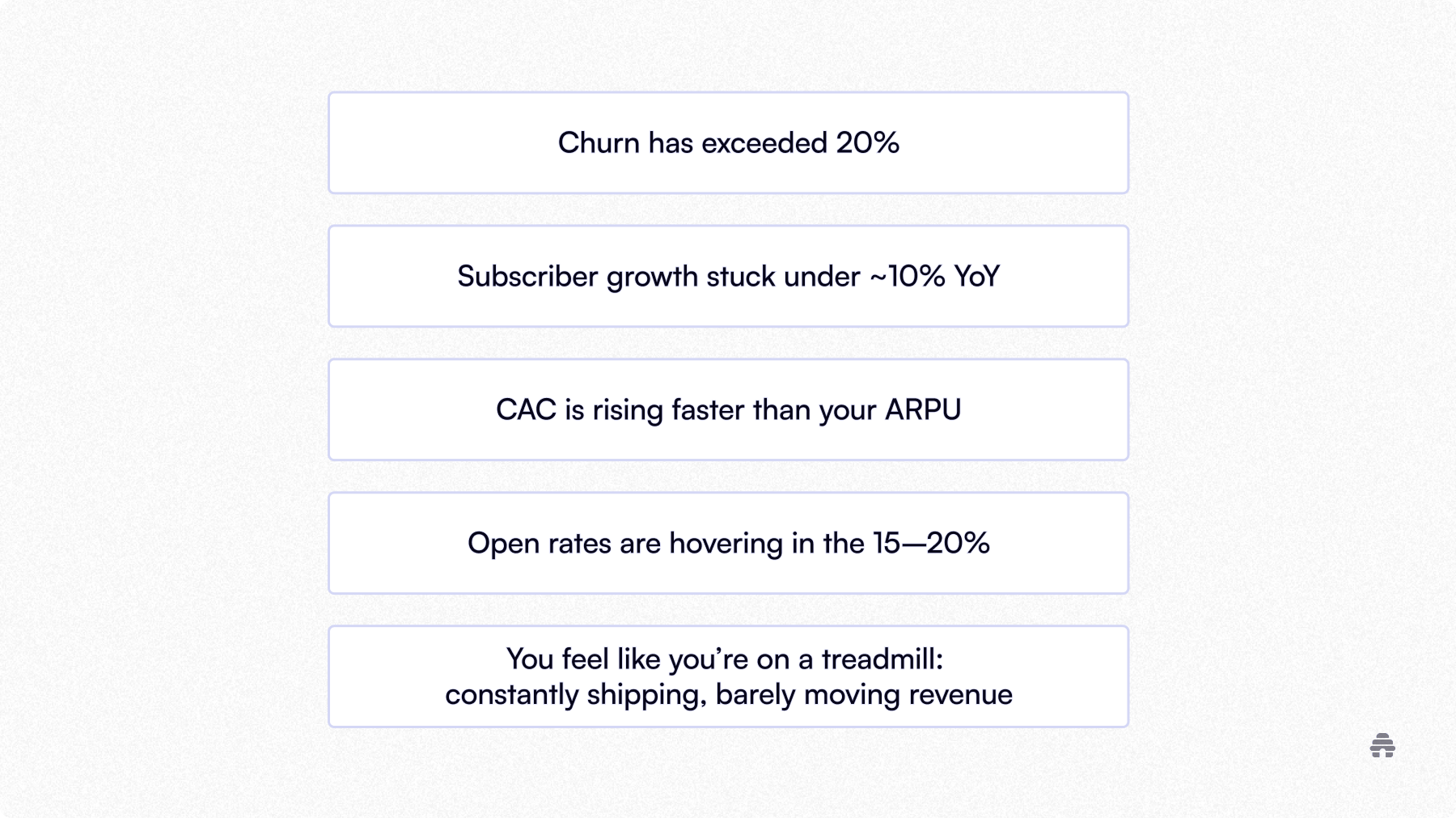
You don’t need a consultant to tell you you’re in the subscription trap. The signs are pretty obvious:
Churn has exceeded 20%, and is trending upward
Subscriber growth stuck under ~10% YoY despite shipping more
CAC is rising faster than your ARPU, even with discounts and trials
Open rates are hovering in the 15–20% range on most sends
You feel like you’re on a treadmill: constantly shipping, barely moving revenue
If most of your income is tied to “people paying every month or nothing,” and these signals are familiar, you’re at the point where more content won’t fix your growth.
You need more paths to revenue.
What Diversification Actually Looks Like (Without Blowing Up Your Brand)
Diversification doesn’t mean throwing your newsletter behind ten different business models overnight.
It means:
Keeping subscriptions
But adding new ways for the same audience to support you
Three big levers in 2025:

1. Ads: Let Brands Help Carry the Load
Digital ad spend hit roughly $740 billion in 2025, about 69% of all ad spend.
A growing chunk of that is shifting away from traditional media toward creator-owned inventory — newsletters, podcasts, vertical media brands.
The old fear was: “Ads will dilute my brand.”
The 2025 reality is:
Readers are used to tasteful, relevant sponsors
70%+ of consumers say creator recommendations speed up their purchase decisions
Ad-supported revenue lets you keep more content free, which supports growth and still pays you
beehiiv’s Ad Network is built exactly for this: connecting newsletters to brands (think Nike, Netflix, HubSpot, AG1, etc.) with:
Native sponsor units
Transparent reporting
Payouts directly into your beehiiv wallet
Publishers on beehiiv have already generated tens of millions of dollars via ads and boosts alone — on top of subscriptions.

2. Boosts: Paid Recommendations as a Growth + Revenue Flywheel
Boosts turn something creators already do — recommending other newsletters — into a structured revenue and acquisition channel.
With Boosts you can:
Get paid when your subscribers opt in to other newsletters
Pay other newsletters to recommend you and grow your list
Turn the “you might also like” section into a predictable customer acquisition engine
For many beehiiv publications, Boosts alone drive 10–20% net-new subscriber growth, while also adding incremental revenue on every send.
Instead of relying on algorithms or paid social, you’re tapping into other creators’ trust.

3. Digital Products: High-Margin Upsells for Your Best Readers
Digital products convert your expertise into assets:
Playbooks & templates
Cohort-based courses
Workshops & trainings
Resource libraries, databases, or tools
The beauty of products:
No recurring obligation — readers can support you once, deeply
High margin — once created, they scale incredibly well
They stack on top of your existing list and audience, instead of competing with your subscription
Across creator platforms, digital products often add 2–3x on top of a creator’s existing subscription or ad revenue.
And on beehiiv, you can now sell digital products natively, connected directly to your newsletter, your website, and your audience data, without bolting on a completely separate stack.
Case Studies: What Diversification Looks Like in Practice

A few real-world patterns we’re seeing in 2025:
Young Money (Jack Raines)
Migrated to beehiiv to escape platform fees and layered in ads and boosts alongside a loyal audience. Result: ~20% uplift in total newsletter revenue—not by publishing more, but by earning with the same audience more intelligently.
GRIT Capital
Brought 360,000 subscribers to beehiiv in 2025. By adding sponsorships and Ad Network campaigns on top of existing paid content, they improved margins by about 15% while maintaining a premium brand and workflow.
Self-Made Millennials & other ConvertKit-style operators
Used digital products (courses, templates, programs) to turn email lists into multi-six-figure businesses. Data across tools shows creators with diversified revenue earning roughly 3x more than those sticking to subscriptions alone.
Different brands, different niches, same pattern:
The ceiling wasn’t the audience size.
It was relying on a single way to get paid.
How To Diversify Your Creator Revenue in 2025 (Without Starting from Scratch)
You don’t need to blow up your business model to get started. You just need to add layers.
Here’s a practical rollout:
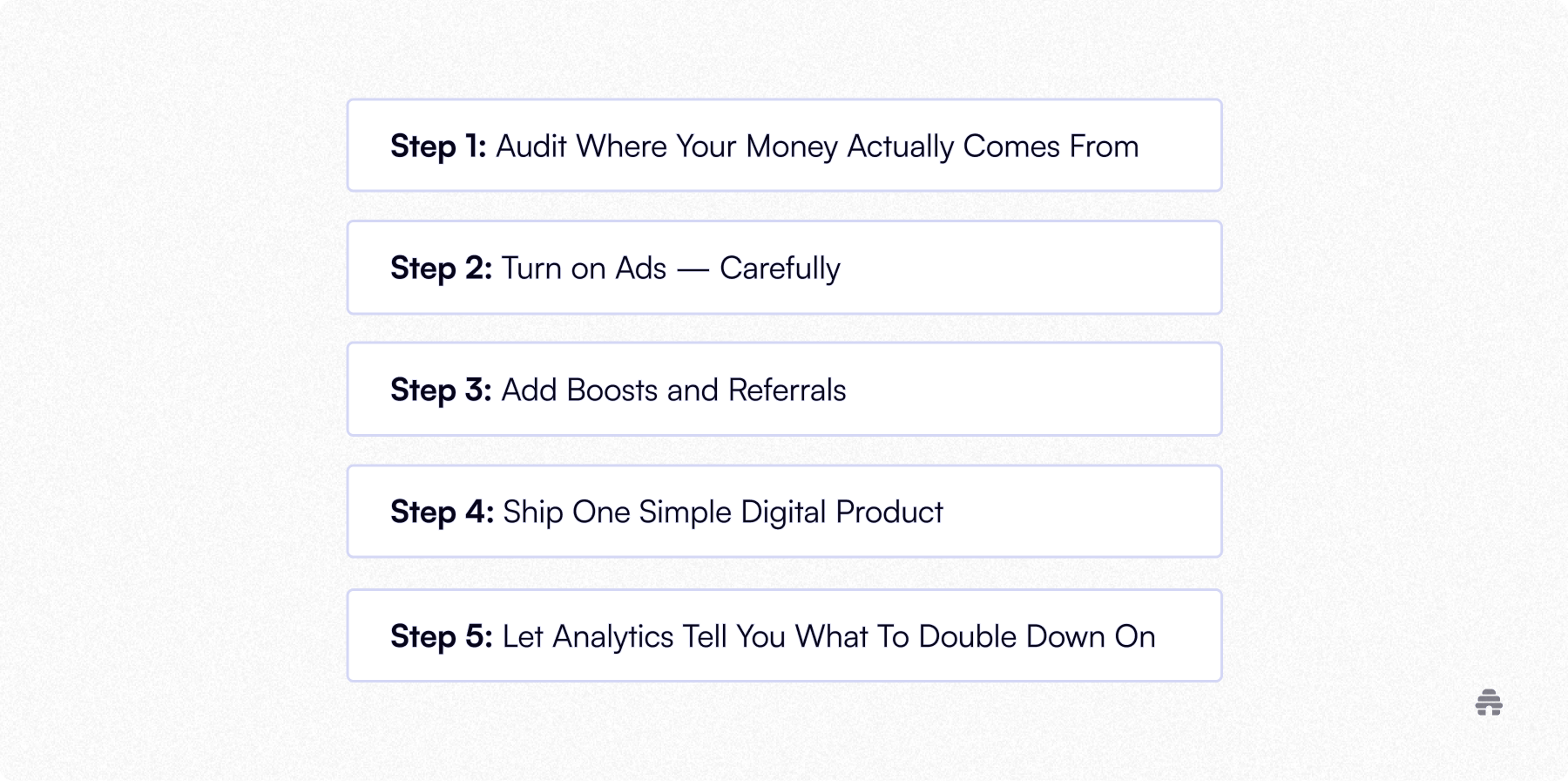
Step 1: Audit Where Your Money Actually Comes From
What % of your revenue is subscription-based?
What’s your current churn, CAC, and YoY growth?
If subscriptions dropped 20% tomorrow, how exposed would you be?
This gives you a baseline and urgency level.
Step 2: Turn on Ads — Carefully
If you’re on beehiiv:
Apply to the beehiiv Ad Network
Start by adding one sponsor slot in a consistent place in your newsletter
Watch RPM per send and reader feedback
You don’t have to go “full ad stack” overnight. Start light, track performance, and expand from there.
Step 3: Add Boosts and Referrals
Enable Boosts so you get paid when subscribers opt into recommended newsletters
Test paid Boosts to grow your own list without relying on paid social
Track new-subscriber quality: opens, CTR, conversion to paid
This is often the easiest “extra” revenue to turn on — no new product to create, just better routing of attention.
Step 4: Ship One Simple Digital Product
Don’t start with a massive flagship course if that feels overwhelming.
Instead:
Take an existing high-performing series or framework
Turn it into a paid guide, workshop, or mini-course
Sell it first to your existing readers via segmented campaigns
Once that validates, you can build out more ambitious product lines over time.
Step 5: Let Analytics Tell You What To Double Down On
Platforms like beehiiv give you:
Revenue per send
Subscriber LTV
Cohort retention
Performance per monetization channel
Use that data to:
Promote what’s working
Kill what isn’t
Set goals per channel instead of just “more subscribers”
The goal isn’t to bolt on every possible path. It’s to find 2–4 strong streams that complement each other and fit your brand.
Why a 0% Platform Fee Actually Matters
One last piece that often gets overlooked: the platform tax.
If your platform takes 10% of your subscription revenue forever, then:
Every pricing decision you make
Every growth campaign you run
Every newsletter you send
… is happening on a base that’s permanently shaved down.
At $50K/year in subs, that hurts.
At $200K/year and beyond, that’s brutal.
Platforms like beehiiv are built on a different assumption:
0% platform fee on subscriptions, ads, and boosts
You keep what you earn
The platform makes money on SaaS pricing, not a tax on your upside
Pair that with native Ads, Boosts, digital products, and advanced analytics, and you’re not just getting a newsletter tool — you’re getting infrastructure for a diversified media business.
Final Thoughts: Subscriptions Are the Foundation, Not the Finish Line
Paid subscriptions changed what was possible for creators. They’re still one of the most powerful models in the ecosystem.
But in 2025:
Digital subscription growth is stalling
Churn is up
CAC is high
Consumer fatigue is real
Platform fees quietly cap your upside
The creators who are winning aren’t abandoning subscriptions — they’re outgrowing paid-only.
They’re stacking:
Subscriptions
Sponsorships and Ad Network revenue
Boosts and paid recommendations
Digital products and services
…on top of the same audience they’ve already worked hard to build.
If you want your newsletter to be more than a single paywall — if you want it to be a business — diversification isn’t a “nice to have” anymore. It’s the growth engine.
And if you want that engine to scale without a permanent 10% drag, you need tools that let you keep your revenue and give you more ways to earn from it.
Thatshift is exactly what beehiiv is built for.



The one place to build.