How Jonathan Levitt Built a High-Trust Podcast Business on beehiiv
How For the Long Run turned a niche podcast Into a multi-channel media business on beehiiv
Table of contents
At a Glance
- Who: Jonathan Levitt, host of For the Long Run and Long Run Labs, and founder of a 35-show podcast network
- Background: Spent 10 years at InsideTracker starting in 2014; launched For the Long Run in 2019
- On beehiiv since: 2023, after evaluating it against ConvertKit (now Kit)
- Runs on beehiiv: Both podcasts, the For the Long Run newsletter, website, and blog
- Catalog: Roughly 500 podcast episodes published over seven years
- Business model: Value-based sponsorships sold across podcast, newsletter, social media, and live events
- Philosophy: Prioritize trust over scale; “find your weird”
By the Numbers
- 500 episodes published over seven years
- 35 shows in his podcast network, 2 of them (For The Long Run and Long Run Labs) on beehiiv
- $850,000 in sales driven for two partners on about $35,000 of spend
- About 1,100 new email leads from one giveaway with roughly $200 in paid promotion
It Started With Access Nobody Else Had
Jonathan Levitt spent ten years at InsideTracker, the athlete health company, starting in 2014.
Around 2018, the job put him in the room with trail runners and elite athletes, and he got curious about what makes someone want to do something that hard. He was falling for trail running himself at the same time, fascinated by people who treated a marathon as a warmup and ran 100, 200, even 300 miles. In 2019, he launched a podcast, For the Long Run, mostly as a way to capture those conversations and share access that few other people had.
It worked almost immediately. Thousands of people were downloading the show, and Levitt realized he was onto something. When the pandemic canceled races, brands that still needed to reach runners came knocking, and he started working with a sock company and an apparel brand, both based in Massachusetts and both products he already used. He hired his first editor in 2021, and by 2022 and 2023 the show was producing a real amount of revenue. A couple of years later, he left the day job and went full-time.
Then he kept building. He launched a second show, Long Run Labs, about the business of the outdoor industry, for the part of his audience that wanted that angle. And he started a podcast network that now includes 35 shows he partners with.
Why Jonnathan Migrated to beehiiv
Levitt landed on beehiiv in 2023, after going back and forth with ConvertKit, now called Kit. beehiiv won as the more creator-focused option. What finally moved the podcast itself over was the beehiiv MCP, the piece that let him connect his data and tools directly. The deeper reason is consolidation.
“The isolated tech stack does not make sense anymore, from both an economic standpoint and a utility standpoint. beehiiv made it possible to log into one less thing.”
-Jonathan Levitt
- Podcast hosting: Previously hosted on Spotify; moved both shows to beehiiv to take advantage of the MCP
- Website: Previously ran on a WordPress site he felt was limiting; rebuilt the entire site in a single weekend using Anthropic Claude and HTML
- Email platform: Considered ConvertKit (now Kit) before choosing beehiiv as the more creator-focused option
- Tech stack: Went from multiple tools and logins to consolidating effort, data, and workflows in one place with beehiiv
For Levitt, the value is not only fewer logins. It is that beehiiv hands a creator a roadmap. If you arrive for the newsletter, the natural next steps are a website and a podcast, with the friction of finding the next tool already removed.
“If you know enough to land at beehiiv, you have three things: email, website, podcast. You could argue those are the most useful mediums that exist in 2026.”
Jonathan Levitt
The Newsletter Came From Wanting to Own the Audience
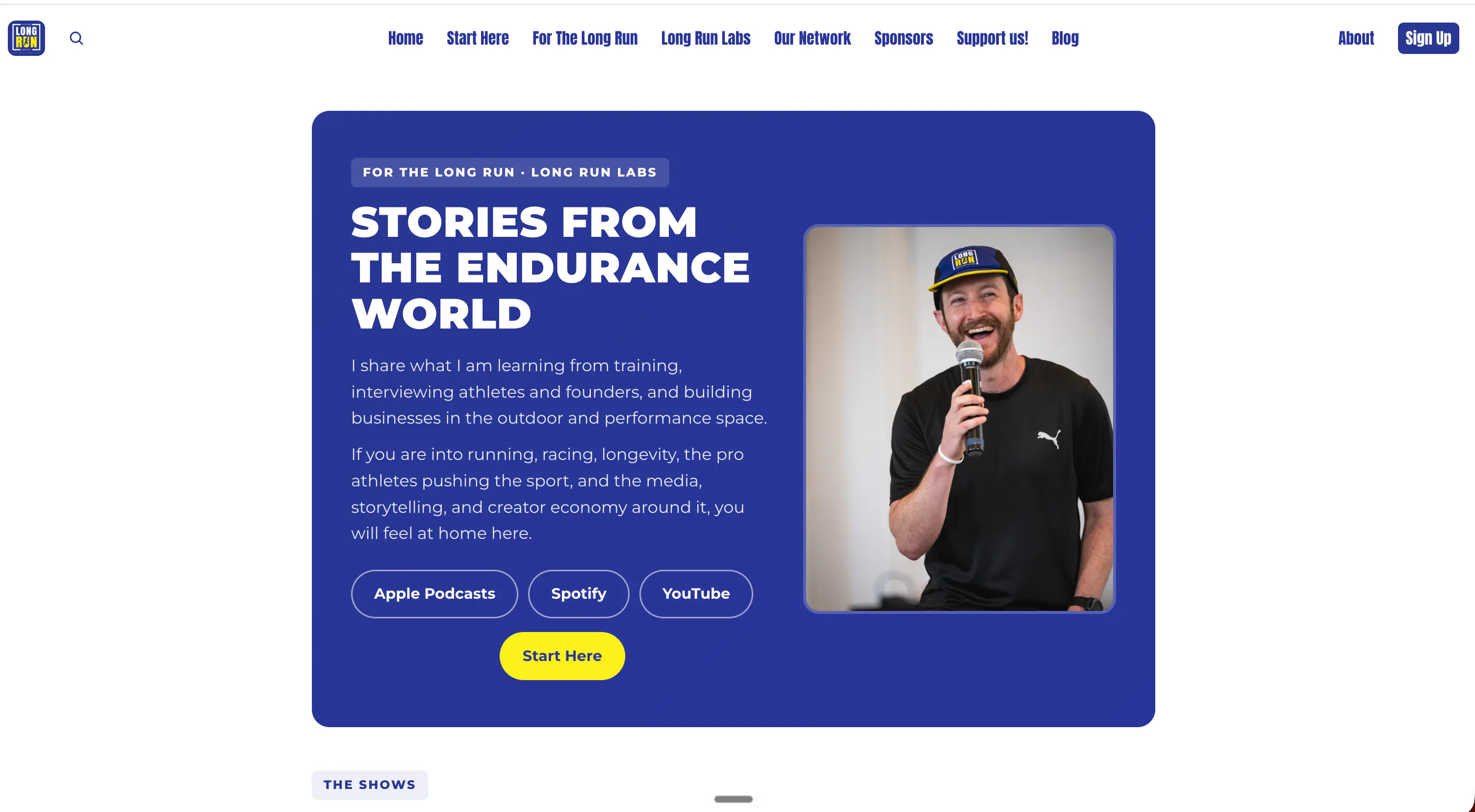
For the Long Run started as a podcast, and the newsletter came later, around the same time as his first website. The push came from a podcast consultant who became the quarterback of the operation and started sending a monthly and weekly email. Having spent years on the brand side, Levitt already knew the value of an email list, and an owned audience, better than most.
He is candid that not everything lives on beehiiv. He writes the Long Run Labs newsletter on Substack, because that show's audience of founders and brand marketers already reads there, and he found subscribers and revenue faster on that platform. He keeps the two separate on purpose. For the Long Run, both podcasts, and his website all run on beehiiv, and after discovering he could drop in his own HTML, he rebuilt the whole site with Claude in a weekend.
How He Sells: Value Over Volume
Levitt stopped selling his own show on a straight CPM basis years ago. He once charged a $200 CPM and brands happily renewed, which told him the number was beside the point. Today most podcast partnerships run through the network, and he layers in newsletter and social media to lift a blended rate that he anchors around $85 to $100 depending on the host. When the fit is right, he has charged a $500 CPM, and it worked.
The bigger shift is selling outcomes instead of impressions.
Across two partnerships with a solar company and a car company, he drove $850,000 in sales against about $35,000 in spend, on roughly 15 to 20 customers. So he leans away from low-ticket CPG and toward higher-ticket value creation. His current Long Run Labs partnership with Popfly, a platform that helps brands scale user-generated content and affiliate programs, shows the model in miniature:
The partnership combines a fixed sponsorship fee with performance-based compensation tied directly to business outcomes. Early results include multiple qualified demos, several customer conversions, and a growing pipeline from offline events, with projected annual revenue impact exceeding six figures.
The thread through all of it is that the multi-channel, outcome-based deals are the ones partners get most excited about, combining the podcast, the newsletter, and an in-person event into one package.
The Flywheel Is a Lot of Surface Area
Levitt's growth tactic is volume of touchpoints. Every For the Long Run episode becomes three video assets, a blog post, and an email, then goes out on Twitter and Threads, with a call to action to join the email list. Every Long Run Labs episode becomes two videos, a LinkedIn post, an X post, and a Substack, and sometimes feeds the beehiiv email. Everything also goes to YouTube, where he has quadrupled views in the last two or three months.
He is the first to admit it is hard to attribute, but the surface area works. Two years ago, a single giveaway with about $200 in paid promotion brought in roughly 1,100 leads, an increase of about a third of his list at the time.
Trust Over Scale
Ask Levitt about subscriber counts and he will tell you the number is not the point. After a couple of hours thinking it through with Claude, he landed on why a smaller show can out-earn far bigger ones: everything he does is anchored in trust. Ten years in the industry, fifteen years posting on Instagram, seven years in listeners' ears. One founder told him he did not need an introduction, because he already knew exactly who Levitt was.
“I'd rather have a hundred super dedicated listeners than 10,000. That long-tail trust is what I'm focused on.”
-Jonathan Levitt
That trust has a shape, and it has a name. An investor he is advising told Levitt his real value is being a connector, of pro athletes to his audience, of founders to capital, of brands to audiences. He hosts a monthly founders event in Boulder and is building versions in Boston and online.
“My North Star is I want to connect someone to something. I make all decisions based on that.”
-Jonathan Levitt
The Paid Tier Is a Tip Jar, for Now
Levitt is honest that his paid tier, Peak Supporters, runs as a patronage model. He used to mail hats and brand swag until he ran out of hats, but the real pitch is simpler. People pay $20 a month for Netflix and six dollars for a coffee, so why not eight dollars for something they spend hours with every month.
The goal is to make revenue less dependent on fickle brand deals, which run light in January and February and strong the rest of the year. His plan is to run an ad-free episode in July with a call to action, and to build toward a baseline of around $1,000 a month rather than $50.
His Advice to Creators: Find Your Weird
When asked what creators should know, Levitt did not hesitate.
“Find your weird. If you're not weird, you're not going to create an audience.”
He created the first podcast to learn from people he admired, and the second to reach people who would never give a cold email an hour but will happily sit for a recorded conversation that reaches thousands. The point, he says, is to build the thing you want to exist, not to copy what already works.
“If everything is driven by curiosity, you'll never run out of ideas or interest.”
-Jonathan Levitt
Start Using beehiiv
Jonathan Levitt's story is a case for consolidation. Two podcasts, a newsletter, a website, and a network, run by someone who would rather spend his time connecting people than logging into five tools. beehiiv is the floor under it: hosting for both shows, a website he rebuilt himself in a weekend, an owned email audience, and a roadmap from newsletter to website to podcast. With monetization features like dynamic ad insertion on the way, the platform is moving toward exactly the kind of creator Levitt already is. If you are building something bigger than a single feed, start using beehiiv.
Related Case Studies
How AI Central Built a 300,000-Reader Media Brand on beehiiv
Alex Fiore treats his newsletter like an investment portfolio, and beehiiv's data, API, and monetization tools are how he manages it.
How a Newsletter for Senior IT Pros Hit a 52% Open Rate and 2× Ad Revenue in One Quarter
How a Content-First Strategy Turned Readers Into Revenue

Scaling a B2B Media Business to Six Figures With beehiiv
How Martech Record Transformed B2B Content Strategy With beehiiv
